2025-10-21 中国科学院(CAS)
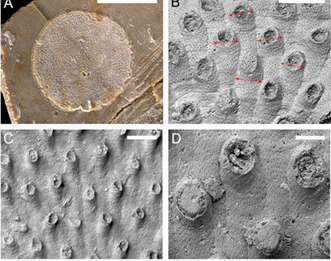
Cyclostome bryozoans of the Berenicea morphotype. (Image by NIGPAS)
<関連情報>
- https://english.cas.cn/newsroom/research_news/earth/202510/t20251021_1089895.shtml
- https://onlinelibrary.wiley.com/doi/10.1111/pala.70027
後期三畳紀から現代までの円口類コケムシにおけるゾイドサイズの縮小 Zooid size reduction in cyclostome bryozoans from the Late Triassic to the present-day
Junye Ma, Lee Hsiang Liow, Paul D. Taylor
Palaeontology Published: 08 October 2025
DOI:https://doi.org/10.1111/pala.70027
Abstract
Body size evolution is a focus of palaeobiological interest, but few studies have examined long-term changes in the size of the modular zooids of colonial animals. Here we investigate changes in zooid size from the Late Triassic to the present-day among encrusting cyclostome bryozoans of a common morphotype attributed informally to ‘Berenicea’. We begin with the naïve hypothesis that cyclostome bryozoans should demonstrate size evolution similar to cheilostome bryozoans, which have maintained a constant mean zooid size. Unexpectedly, a striking pattern of decreasing zooid size through time was found in ‘Berenicea’. We then hypothesized that decreasing levels of oxygen could make smaller zooid sizes more optimal because of their greater surface area/volume; cyclostome zooid size might be tracking a changing adaptive landscape over 200 million years. Despite some evidence for a statistical correlation between ‘Berenicea’ zooid size and oxygen, there is no hint of any causal relationship between them when formal timeseries analysis tools, based on linear stochastic differential equations, are applied. Furthermore, neither origination rates of cheilostomes, known to be superior spatial competitors, nor assemblage-level increases in cheilostome representation, are associated with ‘Berenicea’ zooid size changes. However, there is some support for a switch in the tempo of cyclostome zooid size change at c. 165 to 160 Ma and then again at c. 78 Ma.