2025-10-24 東京科学大学
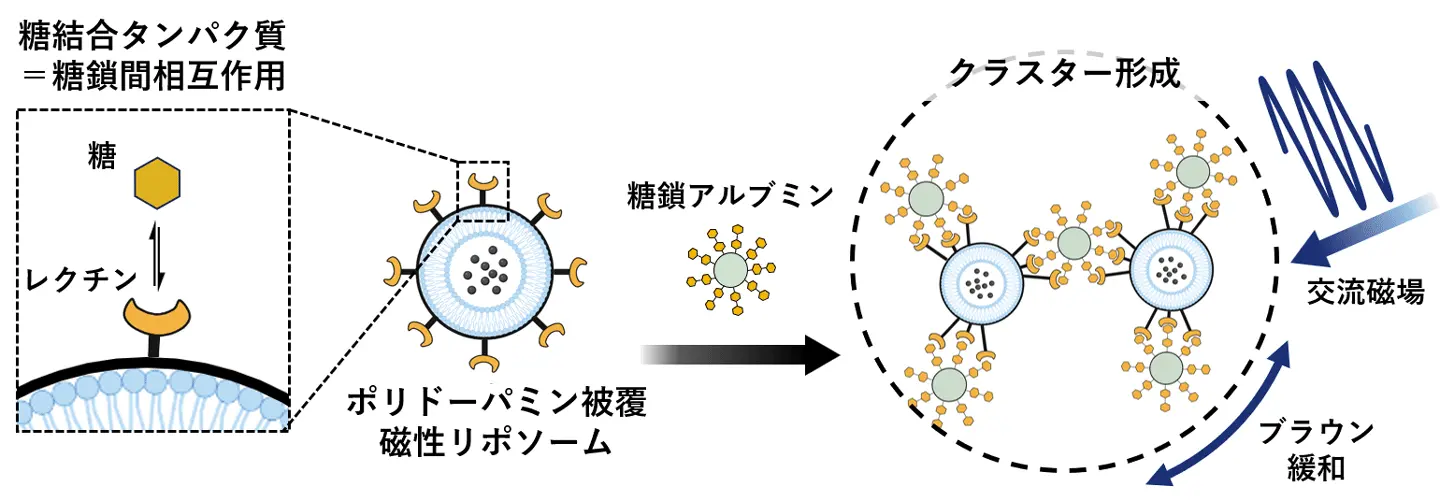
図1. ポリドーパミン被覆磁性リポソームと糖化アルブミンによるクラスター形成と磁気検出
<関連情報>
ポリドーパミン官能化磁性リポソームを用いた磁気プローブによるレクチン-グリカン相互作用解析(ブラウン運動緩和法) Polydopamine-Functionalized Magnetoliposomes as Magnetic Probes for Lectin–Glycan Interaction Analysis through Brownian Relaxation
Adira N. Ryofi,Kyohei Okubo,Akito Nunome,Tsung-Che Chang,Katsunori Tanaka,and Yoshitaka Kitamoto
ACS Applied Materials & Interfaces Published: October 15, 2025
DOI:https://doi.org/10.1021/acsami.5c12462
Abstract
Polydopamine-coated magnetoliposomes (PDA-MLs) are adhesive biocomposite nanomaterials commonly employed in intracellular applications such as controlled drug delivery, theranostics, and biosensing. However, the influence of their adhesive properties on lectin–glycan interactions remains unexplored. In this study, we developed PDA-MLs as magnetic sensing labels for the rapid detection of lectin–glycan binding using alternating current (AC) magnetization measurements in liquid media. The adhesive PDA-ML surface enables facile biomolecule adsorption, facilitating their integration into biosensors. The effects of dopamine-polymerization time on the morphological and functional properties of PDA-MLs were systematically investigated. Extended polymerization resulted in a thicker PDA layer that enhanced lectin immobilization on the ML surface. Multivalent N-glycan-clustered albumin facilitated cross-linking among lectin-immobilized PDA-MLs, leading to remarkable changes in the AC magnetization, compared with interactions with monovalent Gal-N-glycan and Sia-N-glycan. Specific lectin–glycan pairs produced distinct changes in AC magnetization spectra, whereas mismatched combinations showed minimal changes. These findings reveal that structure–property relationships are critical to the design of PDA-ML-based biorecognition systems, highlighting their potential in biosensing and bioanalytical applications.