2025-10-21 奈良先端科学技術大学院大学
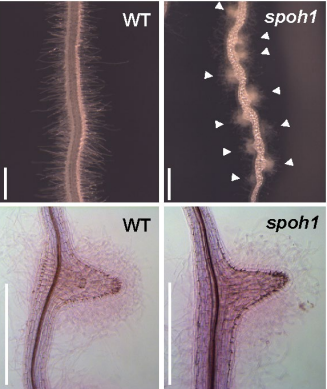
図1 spoh1 変異体は宿主がいない条件で、前駆吸器(白鏃)を形成する(上)。自発的に形成した前駆吸器(右下)の形は、吸器誘導物質により誘導された野生型のもの(左下)と同様であった。
<関連情報>
内因性吸器誘導因子のグルコシル化は寄生植物における血縁回避の基盤となる Glucosylation of endogenous haustorium-inducing factors underpins kin avoidance in parasitic plants
Lei Xiang, Songkui Cui, Simon B. Saucet, Moe Takahashi, […] , and Satoko Yoshida
Science Published:23 Oct 2025
DOI:https://doi.org/10.1126/science.adx8220
Editor’s summary
Parasitic plants can be devastating to crops. Plants in the Orobanchaceae family are typically parasitic but rarely parasitize their own or closely related species. Xiang et al. identified an enzyme in the parasitic plant Phtheirospermum japonicum that conjugates sugars to phenolic compounds involved in stimulating the formation of the parasitic organ called the haustorium (see the Perspective by Runo). By inactivating its own haustorium-inducing factors, the parasitic plant ensures that it will not infect itself or its kin. By comparison, the sugar-conjugation enzyme in the model mustard family plant Arabidopsis thaliana has different substrate specificity, meaning that haustorium-inducing phenolics remain active and the plant can be parasitized. —Madeleine Seale
Abstract
Parasitic plants rarely attack themselves, suggesting the existence of a kin-avoidance mechanism. In the root parasitic plant Phtheirospermum japonicum, prehaustorium formation is triggered by host-secreted haustorium-inducing factors (HIFs), but it is unresponsive to its own exudates. Here we report the identification of the spontaneous prehaustorium 1 (spoh1) mutant, which forms prehaustoria without external host signals. spoh1 harbors a point mutation in the gene encoding uridine diphosphate–glucosyltransferase UGT72B1, an enzyme that glucosylates and thereby inactivates phenolic HIFs. PjUGT72B1 has a different substrate specificity than its ortholog of the host Arabidopsis. Introduction of PjUGT72B1 into Arabidopsis reduced prehaustorium induction activity, indicating that UGT72B1 regulates haustorium induction by hosts. Our findings suggest that Orobanchaceae hemiparasitic plants have evolved kin-avoidance mechanisms through the glucosylation of endogenous HIFs.