2025-10-27 国立遺伝学研究所
<関連情報>
- https://www.nig.ac.jp/nig/ja/2025/10/research-highlights_ja/pr20251027.html
- https://www.nig.ac.jp/nig/images/research_highlights/PR20251027.pdf
- https://febs.onlinelibrary.wiley.com/doi/10.1002/1873-3468.70193
Rad27/FEN1は岡崎断片の蓄積とリボソームDNAコピー数の変化を防ぐ Rad27/FEN1 prevents accumulation of Okazaki fragments and ribosomal DNA copy number changes
Tsugumi Yamaji, Yuko Katayama, Nanase Arata, Mariko Sasaki
FEBS Letters Published: 27 October 2025
DOI:https://doi.org/10.1002/1873-3468.70193
Abstract
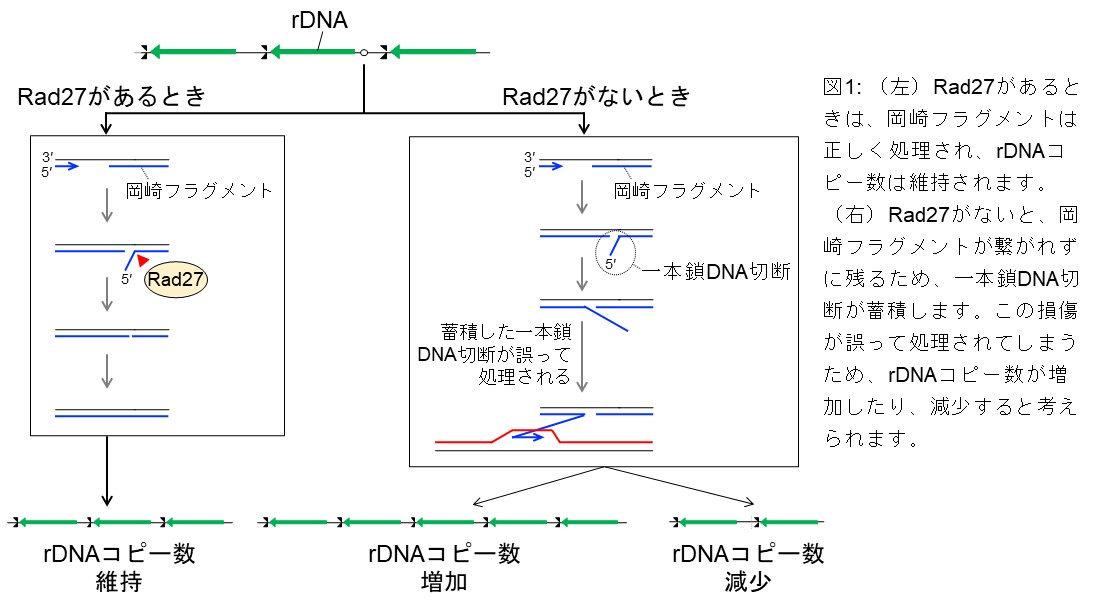
DNA copy number changes are the most frequent genomic alterations in cancer cells. Here, we demonstrate that Rad27/FEN1, a structure-specific nuclease in budding yeast, plays a crucial role in maintaining the stability of the ribosomal DNA (rDNA) repeats. Severe rDNA instability is observed in the rad27∆ mutant, independently of Fob1-mediated DNA replication fork arrest and DNA double-strand break (DSB) formation in the rDNA. The rad27Δ mutant accumulates Okazaki fragments in the rDNA region, without inducing the formation of detectable DSBs. Similar rDNA instability is observed in DNA ligaseCdc9-deficient cells. Furthermore, Exonuclease 1 and PCNA partially compensate for the loss of Rad27 in rDNA stabilization. These findings highlight the importance of proper Okazaki fragment maturation in the maintenance of rDNA stability.