2025-10-28 英国研究イノベーション機構(UKRI)
<関連情報>
- https://www.ukri.org/news/scientists-uncover-how-the-brain-falls-asleep/
- https://www.nature.com/articles/s41593-025-02091-1
眠りに落ちることは予測可能な分岐ダイナミクスに従う Falling asleep follows a predictable bifurcation dynamic
Junheng Li,Anastasia Ilina,Robert Peach,Tianyu Wei,Edward Rhodes,Valeria Jaramillo,Ines R. Violante,Mauricio Barahona,Derk-Jan Dijk & Nir Grossman
Nature Neuroscience Published:28 October 2025
DOI:https://doi.org/10.1038/s41593-025-02091-1
Abstract
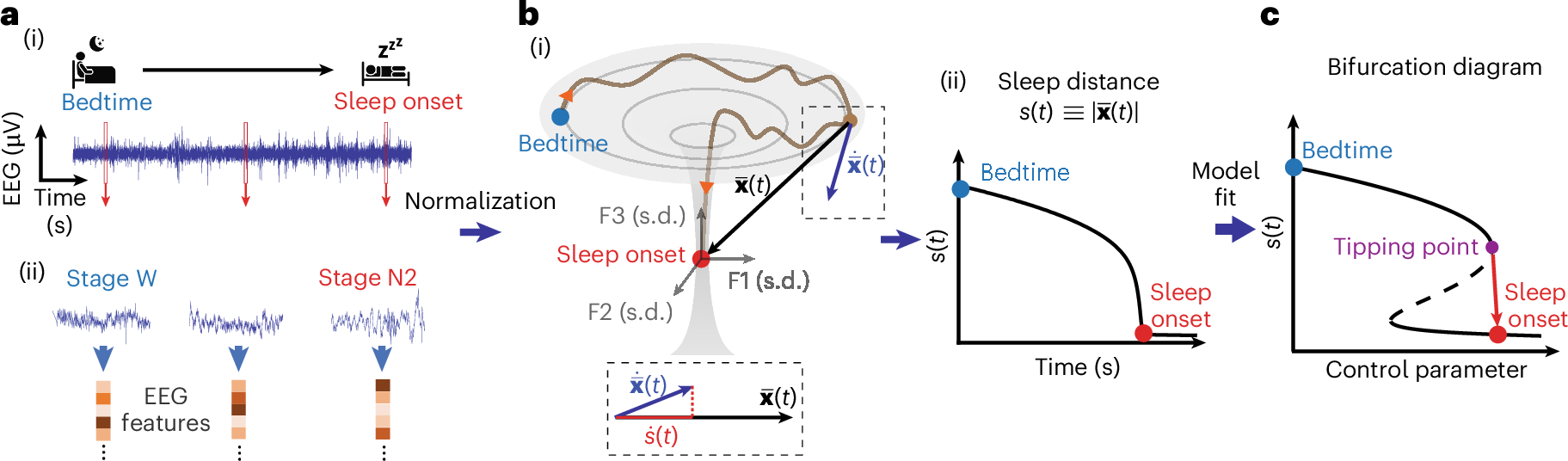
Sleep is a fundamental part of our lives; yet, how our brain falls asleep remains one of the most enduring mysteries of neuroscience. Here we report a new conceptual framework to analyze and model this phenomenon. The framework represents the changes in brain electroencephalogram activity during the transition into sleep as a trajectory in a normalized feature space. We use the framework to show that the brain’s wake-to-sleep transition follows bifurcation dynamics with a distinct tipping point preceded by a critical slowing down. We validate the bifurcation dynamics in two independent datasets, which include more than 1,000 human participants. Finally, we demonstrate the framework’s utility by predicting a person’s progression into sleep in real time with seconds temporal resolution and over 0.95 average accuracy.