2025-11-26 ロックフェラー大学
<関連情報>
- https://www.rockefeller.edu/news/38658-how-the-brain-decides-what-to-remember/
- https://www.nature.com/articles/s41586-025-09774-6
視床皮質転写ゲートが記憶の安定化を調整する Thalamocortical transcriptional gates coordinate memory stabilization
Andrea Terceros,Celine Chen,Yujin Harada,Tim Eilers,Millennium Gebremedhin,Pierre-Jacques Hamard,Richard Koche,Roshan Sharma & Priya Rajasethupathy
Nature Published:26 November 2025
DOI:https://doi.org/10.1038/s41586-025-09774-6
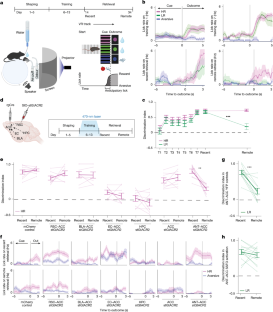
Abstract
The molecular mechanisms that enable memories to persist over long timescales from days to weeks and months are still poorly understood1. Here, to develop insights into this process, we created a behavioural task in which mice formed multiple memories but only consolidated some, while forgetting others, over the span of weeks. We then monitored circuit-specific molecular programs that diverged between consolidated and forgotten memories. We identified multiple distinct waves of transcription, that is, cellular macrostates, in the thalamocortical circuit that defined memory persistence. Of note, a small set of transcriptional regulators orchestrated broad molecular programs that enabled entry into these macrostates. Targeted CRISPR-knockout studies revealed that although these transcriptional regulators had no effects on memory formation, they had prominent, causal and strikingly time-dependent roles in memory stabilization. In particular, the calmodulin-dependent transcription factor CAMTA1 was required for initial memory maintenance over days, whereas the transcription factor TCF4 and the histone methyltransferase ASH1L were required later to maintain memory over weeks. These results identify a critical CAMTA1–TCF4–ASH1L thalamocortical transcriptional cascade that is required for memory stabilization and put forth a model in which the sequential recruitment of circuit-specific transcriptional programs enables memory maintenance over progressively longer timescales.