2025-11-26 中国科学院(CAS)
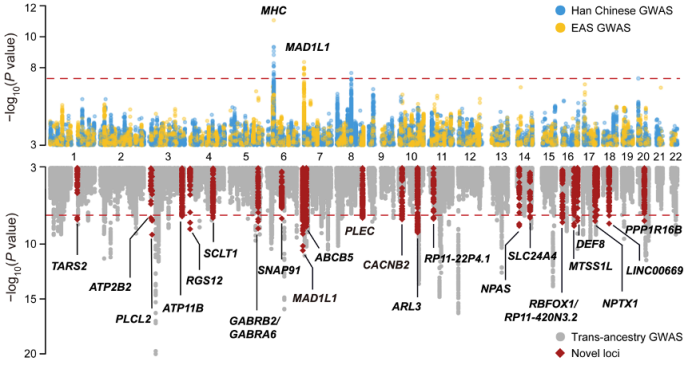
Upper: Manhattan plot for both Han Chinese GWAS and EAS GWAS; Lower: Manhattan plot for trans-ancestry GWAS with 93 GWS loci, among which 23 are novel. (Image by LI Ming)
<関連情報>
- https://english.cas.cn/newsroom/research_news/life/202511/t20251127_1134060.shtml
- https://www.nature.com/articles/s41593-025-02147-2
東アジアおよびヨーロッパの集団における双極性障害のゲノムワイド解析により、遺伝学的発見が促進される Trans-ancestry genome-wide analyses of bipolar disorder in East Asian and European populations improve genetic discovery
Chu-Yi Zhang,Miao Li,Ping Sun,Li Hui,Yuan Gao,Jian-Zhong Yang,Nan Zhang,Xiaoyang Feng,Yong Wu,Lei Guo,Jing Yuan,Hong-Yan Jiang,Yu-Qi Cheng,Simeng Ma,Qian Gong,Yaoyao Sun,Yi Li,Na Qu,Xu-Yuan Yin,Lu Wang,Yongfeng Yang,Chuansheng Wang,Luxian Lv,Dongsheng Zhou,GeseDNA Research Team,… Ming Li
Nature Neuroscience Published:25 November 2025
DOI:https://doi.org/10.1038/s41593-025-02147-2
Abstract
Genome-wide association studies (GWASs) of bipolar disorder (BD) have predominantly included individuals of European (EUR) ancestry, underrepresenting non-EUR populations and limiting insight into disease mechanisms. Here we performed a GWAS of BD in Han Chinese individuals (5,164 cases and 13,460 controls) and conducted comparative and integrative analyses with independent East Asian (EAS, 4,479 cases and 75,725 controls) and EUR (59,287 cases and 781,022 controls) cohorts from the PGC4 GWAS. Our GWAS in EAS ancestry identified two genome-wide significant risk loci, including variants at the major histocompatibility complex (MHC) class II region. Incorporating EAS data into trans-ancestry GWAS revealed 93 significant loci (23 novel). Heritability enrichment analyses implicated a variety of neuronal cell types. Multidimensional post-GWAS prioritization identified 39 high-confidence risk genes, of which 15 were differentially expressed in the brains of patients with BD, 12 modulated BD-relevant behaviors in mice and 18 are pharmacologically tractable. This work advances understanding of the biological underpinnings of BD and provides direction for future research in underrepresented populations.