2025-12-17 マサチューセッツ工科大学(MIT)
<関連情報>
- https://news.mit.edu/2025/new-study-suggests-way-rejuvenate-immune-system-1217
- https://www.nature.com/articles/s41586-025-09873-4
肝臓における栄養因子の一過性再構成は高齢者の免疫力を高める Transient hepatic reconstitution of trophic factors enhances aged immunity
Mirco J. Friedrich,Julie Pham,Jiakun Tian,Hongyu Chen,Jiahao Huang,Niklas Kehl,Sophia Liu,Blake Lash,Fei Chen,Xiao Wang,Rhiannon K. Macrae & Feng Zhang
Nature Published:17 December 2025
DOI:https://doi.org/10.1038/s41586-025-09873-4
Abstract
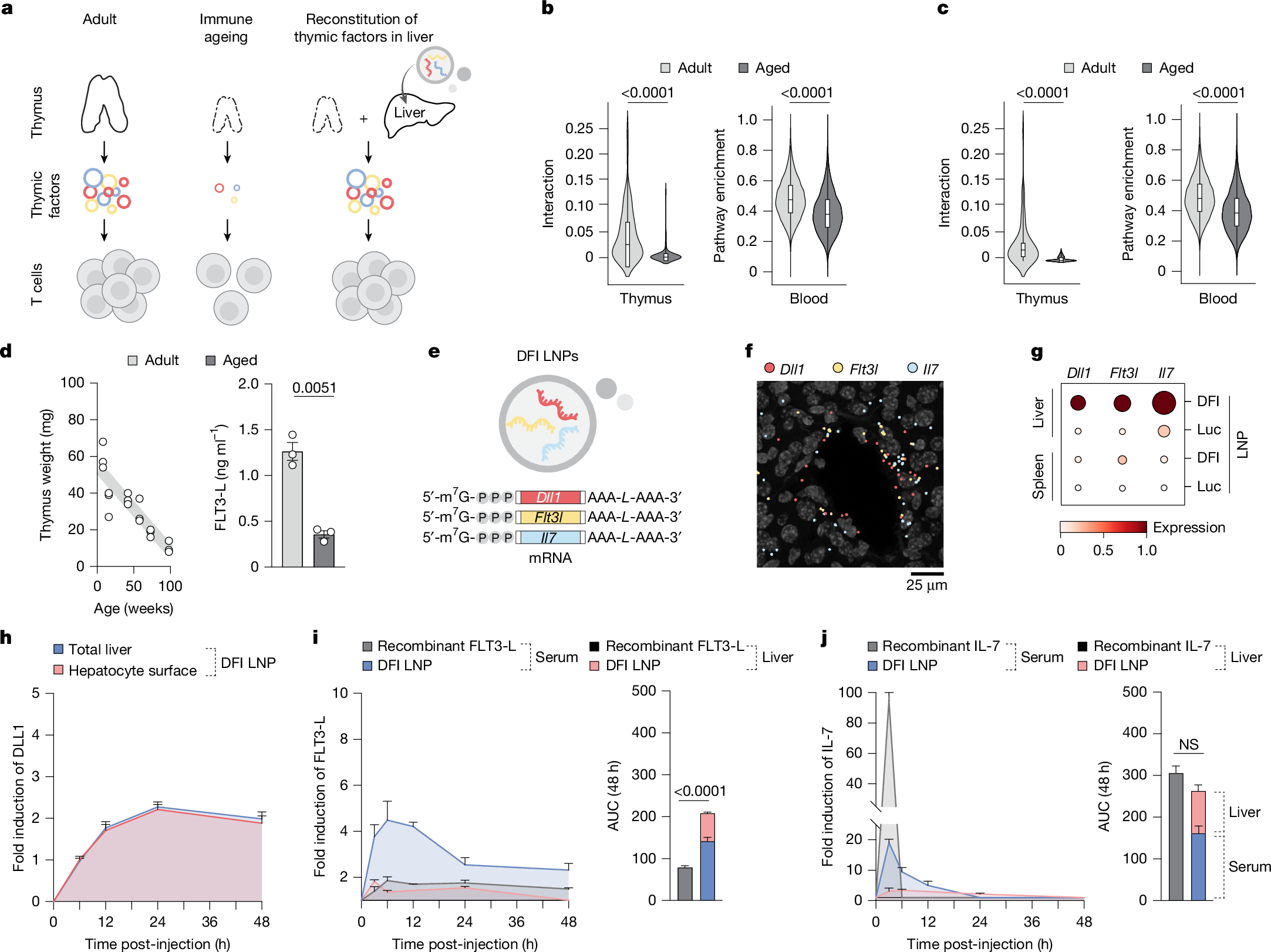
Ageing erodes human immunity, in part by reshaping the T cell repertoire, leading to increased vulnerability to infection, malignancy and vaccine failure1,2,3. Attempts to rejuvenate immune function have yielded only modest results and are limited by toxicity or lack of clinical feasibility1,3,4,5. Here we show that the liver can be transiently repurposed to restore age-diminished immune cues and improve T cell function in aged mice. These immune cues were found by performing multi-omic mapping across central and peripheral niches in young and aged animals, leading to the identification of Notch and Fms-like tyrosine kinase 3 ligand (FLT3L) pathways, together with interleukin-7 (IL-7) signalling, as declining with age. Delivery of mRNAs encoding Delta-like ligand 1 (DLL1), FLT3L and IL-7 to hepatocytes expanded common lymphoid progenitors, boosted de novo thymopoiesis without affecting haematopoietic stem cell (HSC) composition, and replenished T cells while enhancing dendritic cell abundance and function. Treatment with these mRNAs improved peptide vaccine responses and restored antitumour immunity in aged mice by increasing tumour-specific CD8+ infiltration and clonal diversity and synergizing with immune checkpoint blockade. These effects were reversible after dosing ceased and did not breach self-tolerance, in contrast to the inflammatory and autoimmune liabilities of recombinant cytokine treatments6,7. These findings underscore the promise of mRNA-based strategies for systemic immune modulation and highlight the potential of interventions aimed at preserving immune resilience in ageing populations.