2026-01-22 国立遺伝学研究所
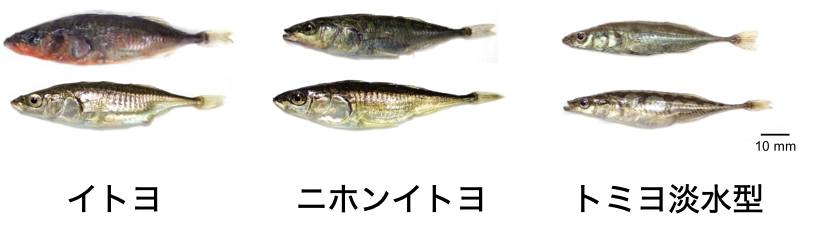
沖根辺沼には、トゲウオ科のイトヨとニホンイトヨという近縁種が、稀に交雑しながらも共存している。トゲウオ科のトミヨ淡水型も沼に生息している。上がオス、下がメス。
<関連情報>
- https://www.nig.ac.jp/nig/ja/2026/01/research-highlights_ja/rh20260122.html
- https://onlinelibrary.wiley.com/doi/10.1111/mec.70249
3つの同所性地域におけるイトヨ類のゲノム分化と遺伝子移入の共通および独自のパターン Shared and Unique Patterns of Genomic Differentiation and Introgression Between Japanese Stickleback Species Across Three Sympatric Sites
Genta Okude, Yo Y. Yamasaki, Takuya K. Hosoki, Hiyu Kanbe, Ryo Kakioka, Atsushi J. Nagano, Manabu Kume, Jun Kitano
Molecular Ecology Published: 21 January 2026
DOI:https://doi.org/10.1111/mec.70249
ABSTRACT
Hybridization and introgression frequently occur even between distantly related species. A central question in speciation research is which genomic regions act as barriers to gene flow and how genome-wide differentiation persists despite hybridization between species. Ecological divergence is well known to promote genomic differentiation, especially during the early stages of speciation. However, the extent to which ecological divergence contributes to genomic divergence and the restriction of gene flow between more strongly isolated species, such as those exhibiting intrinsic hybrid incompatibilities, remains relatively unclear. One promising approach is to compare genomic differentiation and introgression patterns between sympatric sites of ecologically divergent distantly related species and those of ecologically similar species. Here, we identified a new sympatric site of threespine stickleback (Gasterosteus aculeatus) and Japan Sea stickleback (G. nipponicus) in the Okinebe River, Hokkaido, Japan. In this habitat, these two species differ in migratory life histories: G. nipponicus is anadromous (sea-run migratory), whereas G. aculeatus is resident. This contrasts with the other two previously studied sympatric sites, where both species are anadromous. We found that genomic differentiation in the Okinebe pair is maintained at high levels despite limited spatial isolation. Furthermore, the Okinebe pair had more genomic regions with high differentiation and fewer regions of introgression than the other sympatric pairs. These findings suggest that migratory differences may be able to contribute to the restriction of gene flow even between species with strong reproductive isolation. To better understand the role of ecological divergence in speciation, broader comparative studies across multiple sympatric species pairs with varying degrees of ecological differentiation and reproductive isolation are needed.