2026-01-23 京都大学
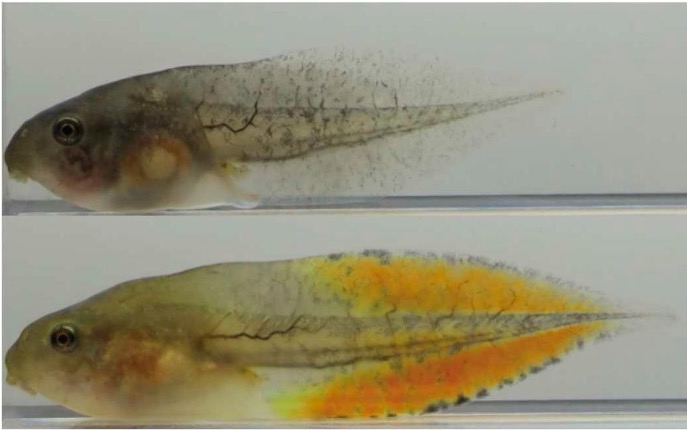
通常のヒガシニホンアマガエル幼生(上)とヤゴによって尾が橙色に変化した幼生(下)(撮影:野田叡寛)
<関連情報>
- https://www.kyoto-u.ac.jp/ja/research-news/2026-01-23-2
- https://www.kyoto-u.ac.jp/sites/default/files/2026-01/web_2601_Watanabe-f2037a0fa34e5a9a949236d585bc97d0.pdf
- https://bioone.org/journals/ichthyology-and-herpetology/volume-113/issue-4/h2025005/Predator-Induced-Tail-Coloration-Toward-Diverse-Dragonfly-Nymphs-in-Tadpoles/10.1643/h2025005.short
ヒガシマアオガエル(Dryophytes leopardus)のオタマジャクシにおける多様なトンボ幼虫に対する捕食者誘導尾色 Predator-Induced Tail Coloration Toward Diverse Dragonfly Nymphs in Tadpoles of the East Japan Tree Frog (Dryophytes leopardus)
Akihiro Noda, Katsutoshi Watanabe
Ichthyology & Herpetology Published:23 December 2025
DOI:https://doi.org/10.1643/h2025005
Abstract
Anuran larvae can change their coloration and morphology to avoid predation. Particularly, some tadpoles in the genus Dryophytes in the Americas develop deep tail fins and bright orange tail coloration in response to predators such as dragonfly nymphs. These conspicuous tails are hypothesized to attract predator attacks, protecting vital body parts from fatal injuries. However, it remains unclear whether the extent of the induced phenotypic changes differs between various predators with distinct feeding patterns and habitats. To explore this, we reared tadpoles of the East Japan Tree Frog, Dryophytes leopardus, with four dragonfly species, water bug, water scorpion, or newt, and measured phenotypic changes, especially focusing on tail coloration. We found that the aeshnid Anax nigrofasciatus, a sit- and-wait predator that climbs on aquatic vegetation, induced bright orange and broad tails of tadpoles. Other odonate species that forage in and on the substrate also elicited tail coloration or deeper larval tails, but it took more time to induce the tadpoles’ response compared to A. nigrofasciatus. In contrast, non-odonate predators did not induce color and morphological changes. This study provides the first evidence of predator-induced tail coloration in an Asian species of Dryophytes, which appears to be a defensive response specifically to dragonfly nymphs, as visually adept predators. Moreover, the differences in the extent and timing of the phenotypic changes among odonate species suggest that anti-predator phenotypes are modulated based on relative predation risks, considering the predators’ foraging patterns and visual capabilities, thereby allowing tadpoles to minimize physiological costs and unintended risks associated with the induced traits.