2026-01-30 京都大学
<関連情報>
- https://www.kyoto-u.ac.jp/ja/research-news/2026-01-30-0
- https://www.kyoto-u.ac.jp/sites/default/files/2026-01/web_2601_Arai-fe5fef5571fc47aadf6b3855912e537f.pdf
- https://www.sciencedirect.com/science/article/pii/S3050597626000072
高齢LBCL患者はCAR-T療法において若年患者と同等の転帰と製品特異的プロファイルを示す Elderly Patients with LBCL Show Comparable Outcomes to Younger Patients and Product-Specific Profiles in CAR-T Therapy
Sho Shibata, Yasuyuki Arai, Junya Kanda, Daisuke Kaji, Daisuke Minakata, Toshio Kitawaki, Kazuyuki Shimada, Tatsu Shimoyama, Satoshi Yoshihara, Shinichi Makita, Nobuharu Fujii, Go Yamamoto, Emiko Sakaida, Yasuhiro Nakashima, Akiyo Yoshida, Yoshihiro Umezawa, Jun Kato, Haryoon Kim, Keisuke Kataoka, Hideki Goto, …,Koji Kato
Blood Immunology & Cellular Therapy Available online: 28 January 2026
DOI:https://doi.org/10.1016/j.bict.2026.100037
Key Points
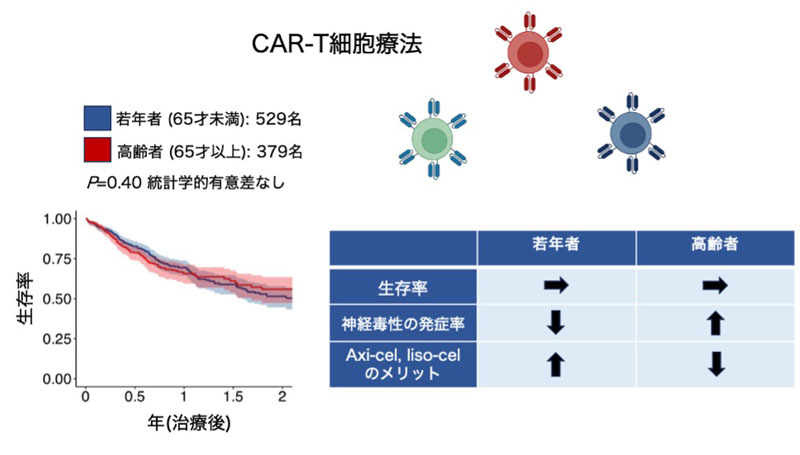
CAR-T therapy shows comparable survival outcomes in elderly and younger patients with large B-cell lymphoma.
Younger: axi-cel and liso-cel improve PFS vs tisa-cel; Elderly: axi-cel increases NRM vs tisa-cel.
Abstract
Anti-CD19 Chimeric Antigen Receptor T-cell (CAR-T) therapy has emerged as a key treatment option for patients with relapsed or refractory large B-cell lymphoma (LBCL). However, data on its effectiveness and safety in elderly populations remain limited, particularly in real-world clinical practice. Moreover, comparative outcomes among different CAR-T products across age groups have not yet been fully characterized. We conducted a nationwide retrospective cohort study using data from the Japanese Society for Transplantation and Cellular Therapy. A total of 908 patients who received CAR-T therapy between January 2019 and September 2024 were included. Patients were categorized as younger (<65 years) or elderly (≥65 years). Subgroup analyses were performed by CAR-T product (tisagenlecleucel, lisocabtagene maraleucel, and axicabtagene ciloleucel). In univariate analysis, 1-year overall survival (OS) and progression-free survival (PFS) were comparable between younger and elderly patients (OS: 69.4% vs. 65.7%, P = 0.40; PFS: 47.9% vs. 54.1%, P = 0.17). In multivariate analysis, age ≥65 showed no significant association with OS (HR: 0.89, 95% CI: 0.65–1.21, P = 0.45). The incidence of immune effector cell-associated neurotoxicity syndrome was significantly higher in elderly patients (12.7% vs. 7.0%, P = 0.005). Compared with tisa-cel, axi-cel and liso-cel were associated with superior PFS, but predominantly in younger patients. Among elderly patients, axi-cel was associated with the higher non-relapse mortality rate compared with tisa-cel. CAR-T therapy is feasible and effective for elderly patients with LBCL. These findings support age-adapted treatment strategies that consider both efficacy and toxicity of each product.