2026-02-09 横浜市立大学
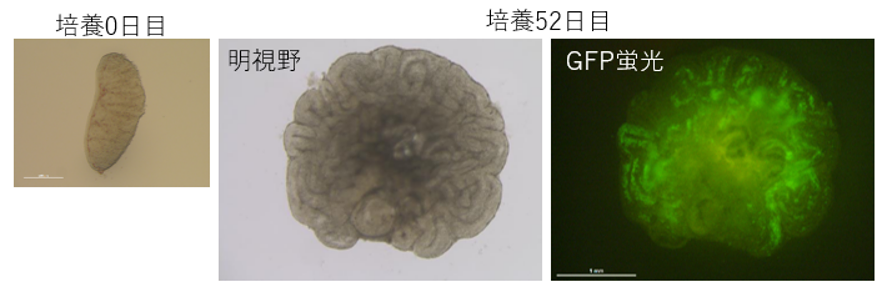
図1 胎仔精巣からの体外精子形成
(左)培養開始時(0日目)の胎仔精巣(胎齢12.5日)。 (中・右)52日間培養した後の精巣組織。
(中)は明視野像、(右)はGFP蛍光像
本研究の条件で培養した組織では、組織自体が成長して精細管が発達するとともに、精子形成が進行していることを示す緑色の蛍光が明瞭に確認できる
<関連情報>
- https://www.yokohama-cu.ac.jp/res-portal/news/20260209sato_comms_bio.html
- https://www.yokohama-cu.ac.jp/res-portal/news/gjok7g0000003edp-att/20260209sato.pdf
- https://www.nature.com/articles/s42003-026-09613-y
逆転写酵素阻害剤は、体外培養でマウス胎児精巣から受精可能な精子細胞を生成することを可能にする Reverse transcriptase inhibitors enable the generation of fertile spermatids from fetal mouse testes in vitro
Mayuka Nishida,Yukina Ono-Sunagare,Sayuri Kato,Yu Ishikawa-Yamauchi,Takafumi Matsumura,Mitsuru Komeya,Shogo Matoba,Kimiko Inoue,Narumi Ogonuki,Atsuo Ogura,Takehiko Ogawa & Takuya Sato
Communications Biology Published:27 January 2026
DOI:https://doi.org/10.1038/s42003-026-09613-y An unedited version of this manuscript
Abstract
Organ culture systems enabling in vitro spermatogenesis from neonatal mouse testes exist, but differentiation from fetal testes shortly after sex determination remains unsuccessful. Here, we report the in vitro generation of fertile haploid cells from E12.5 fetal testes. While optimizing in vitro spermatogenesis protocols for neonatal testes, we find that supplementing the culture medium with reverse transcriptase inhibitors (RTIs) significantly improves the efficiency of spermatogenesis, by suppressing retrotransposon activity and protecting genomic integrity. Applying this approach, we successfully induce spermatogenesis through to the elongating spermatid by culturing E12.5 fetal testes under hypoxic conditions in RTI-supplemented medium. Notably, microinsemination using in vitro-derived spermatids produces healthy and fertile offspring, confirming their functional competence. These findings demonstrate the faithful in vitro recapitulation of testicular development and complete spermatogenesis from an early fetal stage, providing a valuable platform for investigating early germ cell development and reproductive biology.