2026-02-11 ワシントン州立大学(WSU)
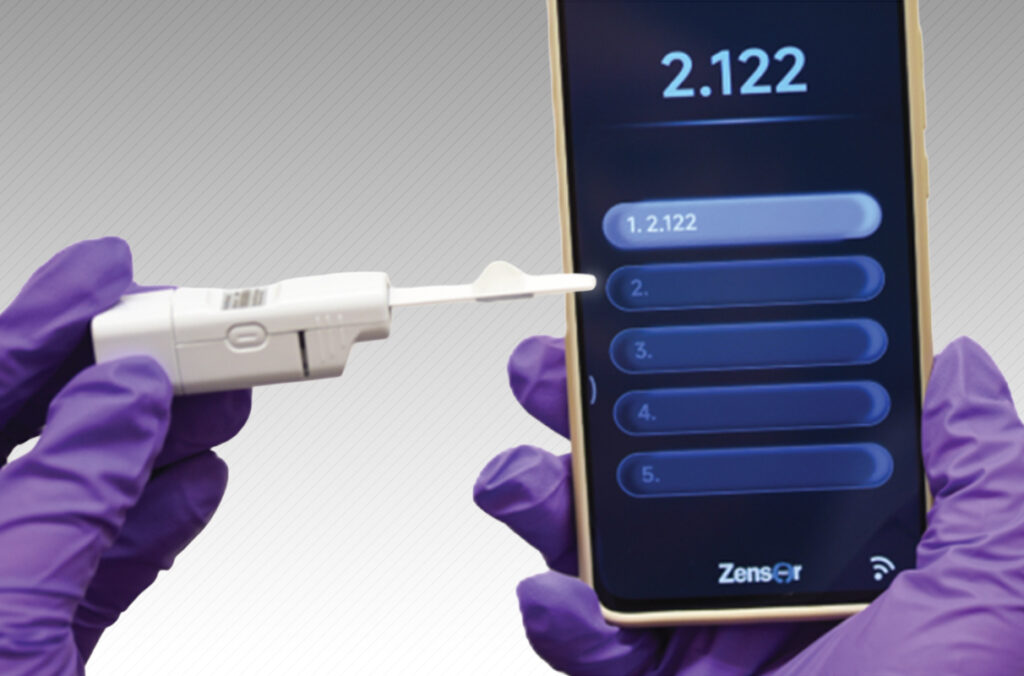
A smartphone application displays a glucose concentration that was measured using a sensor developed at Washington State University. (Photo courtesy of Chuchu Chen and Yonghao Fu)
<関連情報>
- https://news.wsu.edu/press-release/2026/02/11/new-biosensor-technology-could-improve-glucose-monitoring/
- https://pubs.rsc.org/en/content/articlelanding/2026/an/d5an01058f
ワイヤレス血糖モニタリング用3Dプリント中空マイクロニードルベース電気化学センサー 3D-printed hollow microneedle-based electrochemical sensor for wireless glucose monitoring
Chuchu Chen,Yonghao Fu,Yuehe Lin,Yun Liu,Dan Du and Kaiyan Qiu
Analyst Published:23 Jan 2026
DOI:https://doi.org/10.1039/D5AN01058F
Abstract
Wearable electrochemical sensors have aroused tremendous attention due to their great potential for in situ and continuous assessment for glucose monitoring. The conventional fingerstick test is the easiest and most efficient method for glucose evaluation, but it is invasive and painful. Here we introduce a wearable and user-friendly microneedle-based electrochemical sensor, fabricated via resin 3D printing with an affordable desktop 3D printer and featuring a single-atom nanozyme-modified electrode, offering high sensitivity and superior selectivity for glucose monitoring. This minimally invasive electrochemical sensor demonstrates the capability to extract artificial interstitial fluid using hollow microneedles and a finger-activated pump, enabling continuous monitoring of dynamic glucose concentration changes. This electrochemical sensor exhibits remarkable sensitivity and selectivity, with a linear range of 0.1 μM to 50 mM and a limit of detection of 0.285 μM, attributed to the incorporation of single-atom nanozymes with peroxidase-like enzymatic activity. The glucose concentration data are wirelessly transmitted to a smartphone application in real time, offering user-friendly access and facilitating remote monitoring. The described electrochemical sensor presents the possibilities for point-of-care health monitoring applications.