
2026-02-12 京都大学
<関連情報>
- https://www.kyoto-u.ac.jp/ja/research-news/2026-02-12
- https://www.thelancet.com/journals/lanwpc/article/PIIS2666-6065(26)00002-7/fulltext
アルコール摂取、喫煙、そしてそれらの中止が食道における野外発癌に与える影響:10年間の前向きコホート研究 Alcohol consumption, smoking, and the implications of their cessations for field carcinogenesis in the esophagus: a 10-year prospective cohort study
Chikatoshi Katada ∙ Tetsuji Yokoyama ∙ Tomonori Yano ∙ Yasuaki Furue ∙ Haruhisa Suzuki ∙ Kenji Ishido ∙ et al.
The Lancet Regional Health – Western Pacific Published January 19, 2026
DOI:https://doi.org/10.1016/j.lanwpc.2026.101798
Summary
Background
Alcohol and tobacco are established carcinogens, which promote field carcinogenesis for esophageal squamous cell carcinoma (ESCC). This study aimed to evaluate the long-term effects of alcohol and tobacco cessations, and background mucosal status, on risk for metachronous ESCC (mESCC) after endoscopic resection (ER).
Methods
This was a multicentre prospective cohort study of patients with intramucosal ESCC treated by ER. All participants received structured education on cessation, and underwent regular endoscopic surveillance. Patients were stratified by Lugol-voiding lesion (LVL) grade (A: none, B: 1–9, C: ≥10). The impacts of alcohol and smoking cessation on field carcinogenesis were assessed.
Findings
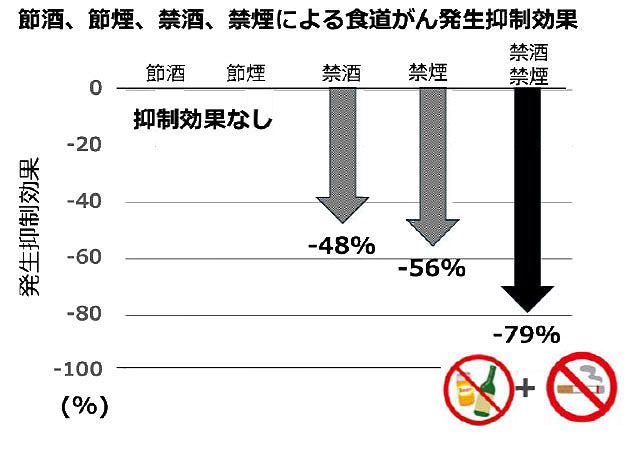
Among 331 enrolled patients, the median follow-up was 120 months (range: 1.3–176.9). The cumulative incidences of mESCC were 10.4%, 27.2%, and 61.8% in grades A, B, and C, respectively. An increment of 1 unit (22 g ethanol) of alcohol consumption and higher LVL grade independently increased the risk for mESCC. Alcohol or smoking cessation reduced this risk (hazard ratio [HR] 0.52, 95% confidence interval [CI]: 0.31–0.88; HR 0.44, 95% CI: 0.25–0.78, respectively), and combined cessation had the greatest impact (HR 0.21, 95% CI: 0.07–0.65). Complete cessation, rather than partial reduction, was necessary to achieve meaningful risk reduction.
Interpretation
Alcohol and tobacco exposure, and a large number of LVL, are major determinants of mESCC. Complete cessation markedly reduces risk, underscoring the importance of behavioural interventions for secondary prevention of field carcinogenesis after ER.
Funding
National Cancer Center Research and Development Fund 36, Japan.
.jpg "なぜヒトの手はこんなに器用? 古い神経回路と新しい神経回路が役割分担して 柔軟さと安定性を両立させていることを発見")