2026-02-18 広島大学,長浜バイオ大学,国立遺伝学研究所,基礎生物学研究所
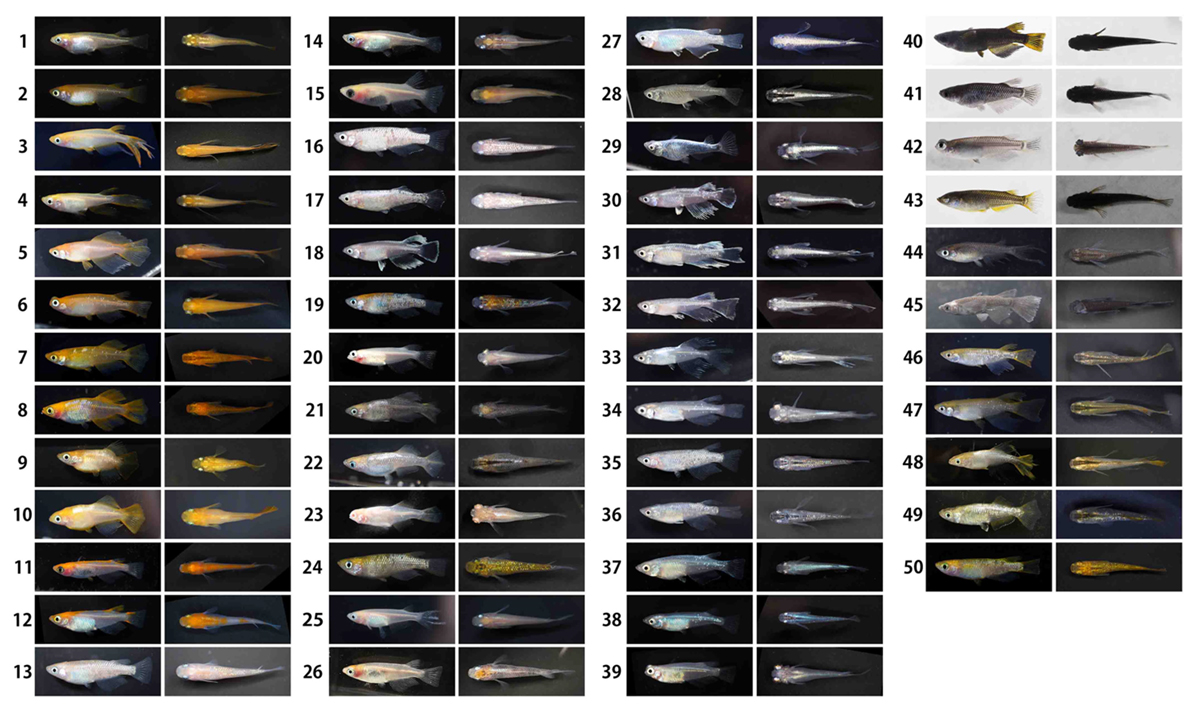
図1:全ゲノム配列解析を行った86品種の観賞メダカの一部の写真(本論文より引用)。
<関連情報>
- https://www.nibb.ac.jp/press/2026/02/18.html
- https://academic.oup.com/mbe/advance-article/doi/10.1093/molbev/msag021/8444924
観賞用メダカの飼育化と体色および形態の多様化によるゲノム的影響 Genomic consequences of domestication and the diversification of body coloration and morphology in ornamental medaka strains
Tetsuo Kon,Rui Tang,Koto Kon-Nanjo,Soma Tomihara,Soichiro Fushiki,Wakana Fujii,Mifuyu Sera,Yusuke Takehana,Hideki Noguchi,Atsushi Toyoda,…
Molecular Biology and Evolution Published:31 January 2026
DOI:https://doi.org/10.1093/molbev/msag021
Abstract
Ornamental medaka strains derived from wild Japanese medaka (Oryzias latipes species complex) are bred worldwide. Over 200 years of selective breeding have produced over 700 strains with a wide variety of phenotypes, including diverse body coloration, scales, eyeball morphology, and fin and body shapes. In this study, we first identified and described 34 phenotypes in ornamental medaka strains. To understand the genomic basis of this phenotypic diversity and the domestication process, we performed whole genome sequencing on 181 individuals of 86 ornamental Japanese medaka strains. Population genomic analyses revealed that modern ornamental medaka strains are genetically closer to the wild Southern Japan population of the Kansai–Setouchi regions, suggesting the origin of ornamental strains. In addition, the gene loci poc1a, tyr, nme2a, and gabrr2b have undergone selection during domestication. We performed GWAS analysis for 29 phenotypes observed in ornamental medaka strains and identified strong candidate genes for some phenotypes, including kcnq5a for hirenaga and swallow, bmp5 for deme, adcy5 for orochi, and kitlga for aurora, respectively. We found that loss of exon 8 of adcy5 caused melanism, a dark body color phenotype, in medaka, providing a molecular insight on this phenomenon in vertebrates and human inherent dyskinesia. In addition, we uncovered the predominant candidate peaks of GWAS, including a total of 3,328 genes associated with 26 phenotypes. Our findings highlight the potential of population genomics to explore genotype-phenotype correlations and the genomic basis of body coloration and morphogenesis in medaka.