2026-02-26 スイス連邦工科大学ローザンヌ校(EPFL)
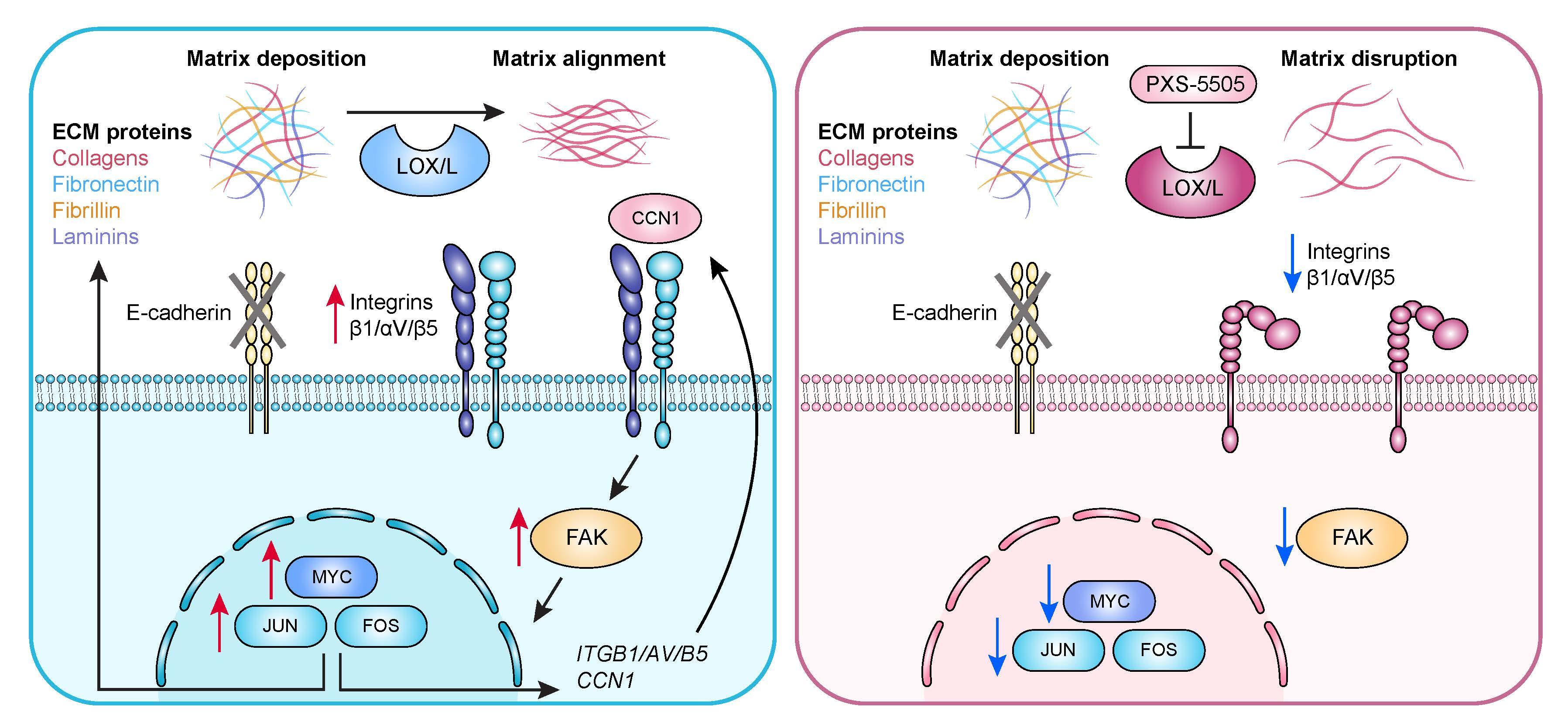
Model of PXS-5505 in action. In the absence of CDH1 the deposition and sensing of matrix components via integrins compensates and controls key transcriptional mediators, LOX inhibition perturbs this signaling axis, resulting in signaling and cell loss. Credit: Flaherty et al 2026 (DOI: 10.1158/0008-5472.CAN-25-3490)
<関連情報>
- https://actu.epfl.ch/news/a-promising-new-drug-for-an-invasive-type-of-breas/
- https://aacrjournals.org/cancerres/article/doi/10.1158/0008-5472.CAN-25-3490/774677/LOX-Inhibition-Disrupts-a-Collagen-Integrin-MYC
LOX阻害はコラーゲン-インテグリン-MYC軸を破壊し、浸潤性小葉癌の進行を抑制する LOX Inhibition Disrupts a Collagen-Integrin–MYC Axis to Suppress Progression of Invasive Lobular Carcinoma
Renée L. Flaherty;Flavia Hughes;George Sflomos;Carlos Ronchi;Harriet Kemp;Theodoros I. Roumeliotis;Anya A. Nicholas;Giovanna Ambrosini;Amelie Ziehme;Sarah Becker;William W. Yang;Yueyun Zhang;Hazel M. Quinn;Laura Battista;Harveena Padda;Solène Pezot;Samuel Jouny;Yanbo Liu;Rachel Brough;Rebecca Marlow;Marjan Iravani;Alicia FC. Okines;Nicholas C. Turner;Athina Stravodimou;Khalil Zaman;Maryse Fiche;Beatrice A. Howard;Jyoti S. Choudhary;Victoria Sanz-Moreno;Clare M. Isacke;Lara Perryman;Wolfgang Jarolimek;Syed Haider;Christopher J. Lord;Cathrin Brisken
Cancer Research Published:February 18 2026
DOI:https://doi.org/10.1158/0008-5472.CAN-25-3490
Abstract
Invasive lobular carcinoma (ILC) accounts for 15% of breast cancers yet lacks specific therapy because ILCs are underrepresented in clinical trials and preclinical models are lacking. Here, we established intraductal xenograft models to test whether the clinical pan-lysyl-oxidase inhibitor PXS-5505, now in phase I/IIa trials for myelofibrosis, can exploit the collagen-rich matrix dependency in ILC created by CDH1 loss. PXS-5505 remodeled fibrillar collagen and halted tumor expansion and metastatic seeding across ER+ and triple negative models without systemic toxicity. Genome-wide CRISPR screens revealed ITGAV and ITGB5 as synthetic lethal partners of CDH1, and LOX inhibition downregulated their expression, together with MYC, NF-κB, and AP-1 transcriptional programs. Collagen fiber density/alignment and MYC/AP-1 gene signatures served as pharmacodynamic readouts of drug activity. These data uncover a tractable ECM-integrin-MYC axis in ILC and nominate PXS-5505, alone or with endocrine therapy, for window of opportunity trials in this understudied breast cancer subtype.