
2026-03-05 慶應義塾大学医学部,理化学研究所
<関連情報>
- https://www.keio.ac.jp/ja/press-releases/2026/3/5/28-172979/
- https://www.keio.ac.jp/ja/press-releases/files/2026/3/5/260305-1.pdf
- https://www.nature.com/articles/s41586-026-10205-3
食餌のシグナルに応答した腸内細菌介在性のベージュ脂肪細胞誘導 Microbiota-mediated induction of beige adipocytes in response to dietary cues
Takeshi Tanoue,Manabu Nagayama,Ayumi J. A. Roochana,Samuel Zimmerman,Orr Ashenberg,Tanvi Jain,Ryo Igarashi,Satoshi Sasajima,Kozue Takeshita,Nicola Hetherington,Nobuyuki Okahashi,Masahiro Ueda,Morichika Konishi,Yoshiaki Nakayama,Aki Minoda,Ashwin N. Skelly,Yasuhiko Minokoshi,Nicholas Pucci,Daniel R. Mende,Makoto Arita,Hironori Yamamoto,Shunji Watanabe,Kouichi Miura,Scott W. Behie,… Kenya Honda
Nature Published:04 March 2026
DOI:https://doi.org/10.1038/s41586-026-10205-3
Abstract
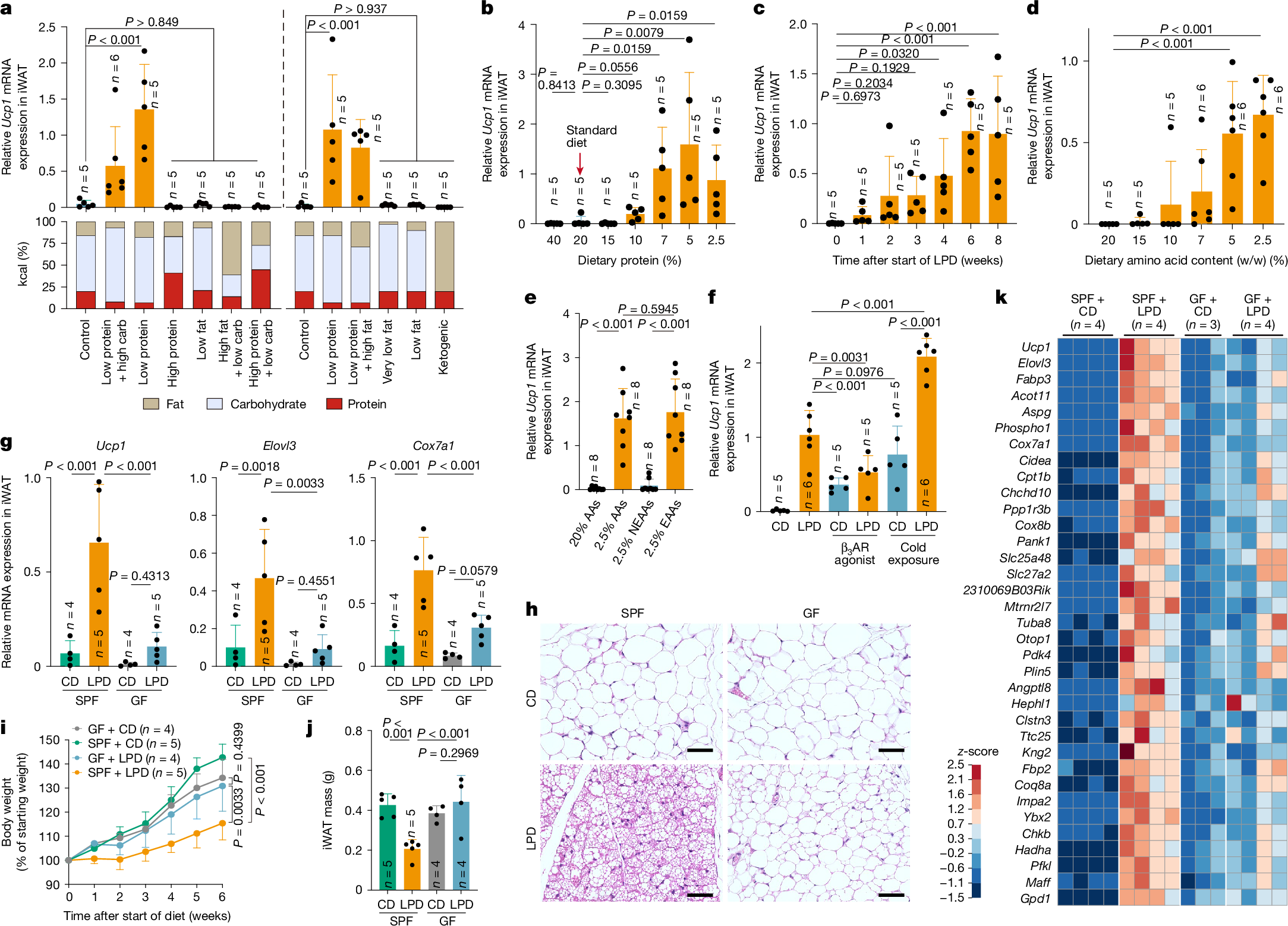
Interactions between diet and the gut microbiota are fundamental to metabolic health, shaping energy balance and disease susceptibility1,2,3,4,5. However, the underlying mechanisms by which dietary and microbial factors converge to regulate host physiology remain unclear. Here we show that protein availability profoundly modulates the functional landscape of the gut microbiota and promotes remodelling of white adipose tissue (WAT). Specifically, low-protein diets (LPDs) robustly induce signature genes of browning in WAT to a similar extent to that seen in response to classical stimuli, such as cold exposure or β-adrenergic receptor activation6,7,8. LPD-mediated browning was markedly diminished in germ-free mice, and this defect was rescued by colonization with defined bacterial consortia made up of strains that were isolated and down-selected from the faeces of either LPD-fed mice or healthy human volunteers with 18F-fluorodeoxyglucose positron emission tomography (FDG-PET)-confirmed brown- or beige-fat activity9,10,11,12. Microbiota-induced browning was mediated both by bile acids driving the activation of the farnesoid X receptor (FXR) in adipose progenitor cells, and by nrfA-encoding commensal-derived ammonia driving the expression of fibroblast growth factor 21 (FGF21) in hepatocytes. The bile acid–FXR and ammonia–FGF21 axes both have non-redundant, essential roles in promoting WAT browning. These findings highlight a mechanistic link between diet, gut microbial metabolism and adipose tissue remodelling, uncovering microbiota-dependent pathways by which the host responds to dietary cues.

