2026-03-06 東北大学
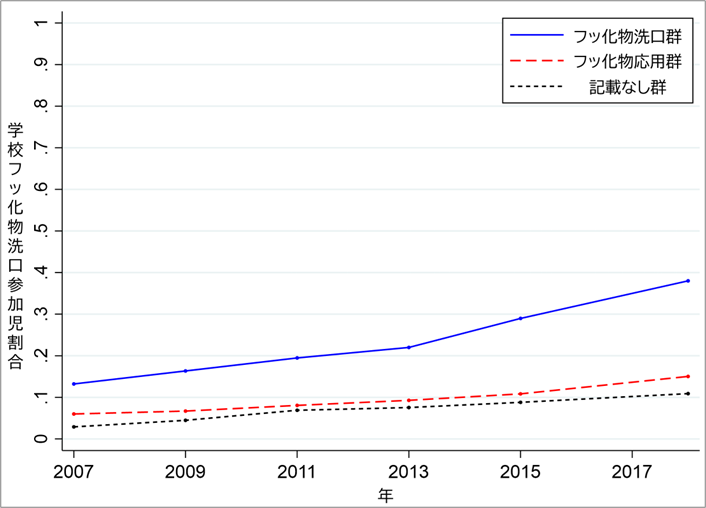
図1. 2007~2018年における学校フッ化物洗口に参加する子どもの割合の推移
<関連情報>
- https://www.tohoku.ac.jp/japanese/2026/03/press20260306-02-dental.html
- https://www.tohoku.ac.jp/japanese/newimg/pressimg/tohokuuniv-press20260306_02_dental.pdf
- https://www.frontiersin.org/journals/oral-health/articles/10.3389/froh.2026.1780911/full
都道府県歯科保健条例におけるフッ化物関連明示文言が日本におけるフッ化物洗口プログラムの普及に及ぼす影響:準実験的研究 Impact of explicit fluoride-related language in prefectural dental health ordinance on fluoride mouth-rinse programs dissemination in Japan: a quasi-experimental study
Manami Hoshi-Harada,Chieko Taguchi,Yoichi Ishizuka ,,Azusa Ishiguro,Yusuke Matsuyama,Jun Aida,Ken Osaka,Kenji Takeuchi
Frontiers in Oral Health Published:02 March 2026
DOI:https://doi.org/10.3389/froh.2026.1780911
Abstract
Objectives:
To estimate the impact of explicit fluoride-related language in prefectural dental health ordinance on the dissemination of school-based fluoride mouth-rinse (S-FMR) programs.
Methods:
A longitudinal ecological design was employed to analyze prefectural-level panel data from Japan spanning 2007 to 2018. Ordinances enacted between 2010 and 2014 were categorized by the presence of explicit fluoride-related terms: 1) explicit mention of “fluoride mouth-rinse” (FMR group); 2) explicit mention of “fluoride application” (FA group); and 3) no fluoride-related policy language (NF group). The outcome was the proportion of children aged 4–15 years participating in S-FMR programs. Total prefectural income per year, prefectural mean age, and prefectural mean number of decayed, missing, or filled primary teeth (dmft) among 3-year-old children were included as covariates. The Callaway and Sant’Anna Difference-in-Differences (CSDID) method was applied to estimate the average treatment effects on the treated (ATT) for the FMR and FA groups under a conditional parallel trends assumption.
Results:
A total of 39 prefectures were analyzed. The pre–post increase in S-FMR participation was greater in the FMR group than in the FA or NF groups, with comparable differences (FMR: 12%; FA and NF: 5% each). In the CSDID analysis, both the FMR and FA groups showed a significant increase in S-FMR participation compared with the NF group, with a larger effect in the FMR group [FMR: 8% (95% CI: 2%–15%); FA: 5% (95% CI: 0%–9%)]. The event-study estimates indicated that the effects strengthened over time, particularly in the FMR group.
Conclusions:
Prefectural dental health ordinances explicitly refer to fluoride, particularly FMR, are associated with a greater dissemination of the proportion of children participating in S-FMR programs. These findings suggest that more specific and explicit policy language in dental health ordinances may enhance the dissemination of S-FMR programs.