2026-03-10 韓国基礎科学研究院(IBS)
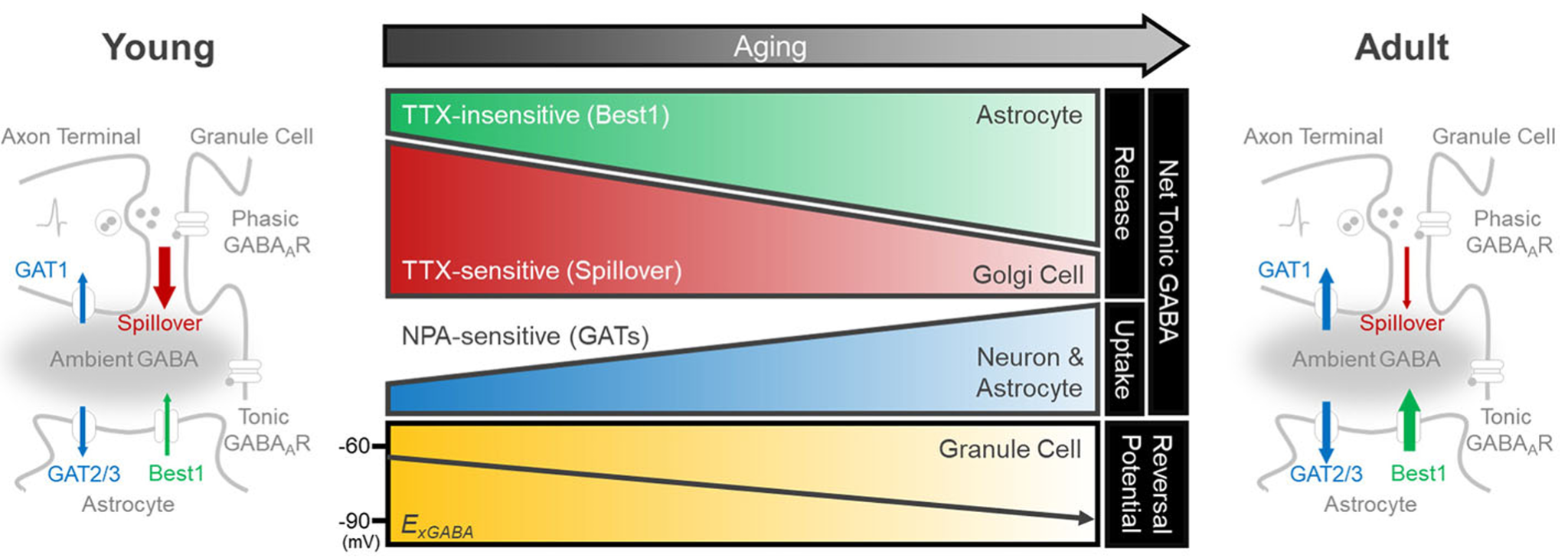
Figure 1. Transitions of tonic inhibition in cerebellar granule cells during adolescence. Astrocyte-released GABA (green) increases, spillover GABA (red) from inhibitory neurons (Golgi cells) decreases, while GABA uptake by transporters (blue) becomes more effective. A set point voltage (reversal potential) for GABA-activated inhibitory current decreases, enhancing GABA’s inhibitory action.
<関連情報>
- https://www.ibs.re.kr/cop/bbs/BBSMSTR_000000000738/selectBoardArticle.do?nttId=26571&pageIndex=1&searchCnd=&searchWrd=
- https://www.nature.com/articles/s12276-026-01657-8
小脳の緊張性抑制は情報処理と運動協調の成熟を調整する Cerebellar tonic inhibition orchestrates the maturation of information processing and motor coordination
Jea Kwon,Sunpil Kim,Junsung Woo,Keiko Tanaka-Yamamoto,Oliver James,Erik De Schutter,Sungho Hong & C. Justin Lee
Experimental & Molecular Medicine Published:18 February 2026
DOI:https://doi.org/10.1038/s12276-026-01657-8
Abstract
Tonic inhibition in cerebellar granule cells is crucial for maintaining information coding fidelity during motor coordination. It arises through both activity-dependent and activity-independent mechanisms, and the interplay between these mechanisms changes with age. However, specific molecular and cellular mechanisms and how their change affects network-level computation and motor behavior remain unclear. Here we show that, while net tonic inhibitory current remains unchanged, the main source of tonic γ-aminobutyric acid switches from synaptic spillover (neuronal activity dependent) to astrocytic Best1 (activity independent) throughout adolescence (4–8 weeks) in mice. Computational modeling based on experimental data demonstrated that this switch downregulates the internally generated network activity mediating mutual inhibition between granule cell clusters receiving different inputs, thereby enhancing their independence. Consistent with simulations, three-dimensional posture analysis revealed an age-dependent increase in independent limb movements during spontaneous motion, which was impaired in Best1-knockout mice. Our findings highlight the late-stage development of complex motor coordination driven by the emergence of astrocyte-mediated tonic inhibition.