2026-03-19 中国科学院(CAS)
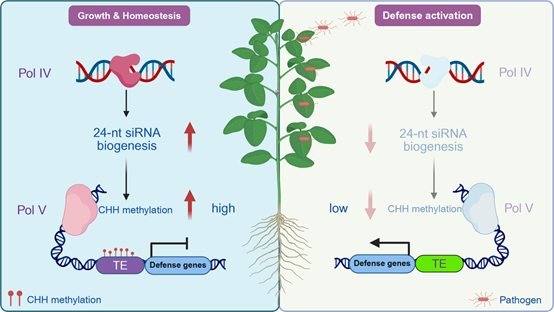
RdDM maintains the homeostasis of plant defense in soybean. (Image by IGDB)
<関連情報>
- https://english.cas.cn/newsroom/research-news/202603/t20260320_1153082.shtml
- https://academic.oup.com/plcell/advance-article-abstract/doi/10.1093/plcell/koag033/8504057?redirectedFrom=fulltext&login=false
小型RNAによるDNAメチル化は、Pol IVおよびPol Vによってダイズの免疫恒常性を維持する Small RNA–directed DNA methylation by Pol IV and Pol V maintains immune homeostasis in soybean
Ziming Zhang ,Hongda Sun ,Mingwei Wu ,Jinfeng Chen ,Yuan Wang
The Plant Cell Published:03 March 2026
DOI:https://doi.org/10.1093/plcell/koag033
Abstract
Transposable element (TE) insertions and DNA methylation variability are frequently associated with defense-related genes in Arabidopsis thaliana. Pathogen infections trigger genome-wide DNA demethylation, suggesting a critical role for DNA methylation in immune regulation. However, the precise function of DNA methylation, as a host defense mechanism or a byproduct of pathogenesis, remains unclear, partly due to the weak correlation between methylation and gene expression in Arabidopsis. Here, we show that in soybean (Glycine max), the canonical RNA-directed DNA methylation (RdDM) pathway in soybean, mediated by RNA Polymerases IV (Pol IV) and V (Pol V), plays a central role in preventing premature activation of many key genes in immune response, including genes encoding Nucleotide-binding Leucine-rich Repeat Receptors and components of the ENHANCED DISEASE SUSCEPTIBILITY 1 pathway. In pol iv and pol v mutants, these defense genes are often located near TEs and lose DNA methylation and become activated to levels comparable to those in wild-type plants under pathogen attack. This misregulation drives constitutive immune gene expression and triggers a severe autoimmune phenotype, even in the absence of infection. Moreover, we reveal that RdDM-mediated epigenetic surveillance is dynamically modulated in response to pathogen exposure. These results indicate that RdDM serves as an active regulatory brake that allows plants to fine-tune immune responses.