2026-03-26 量子科学技術研究機構,琉球大学
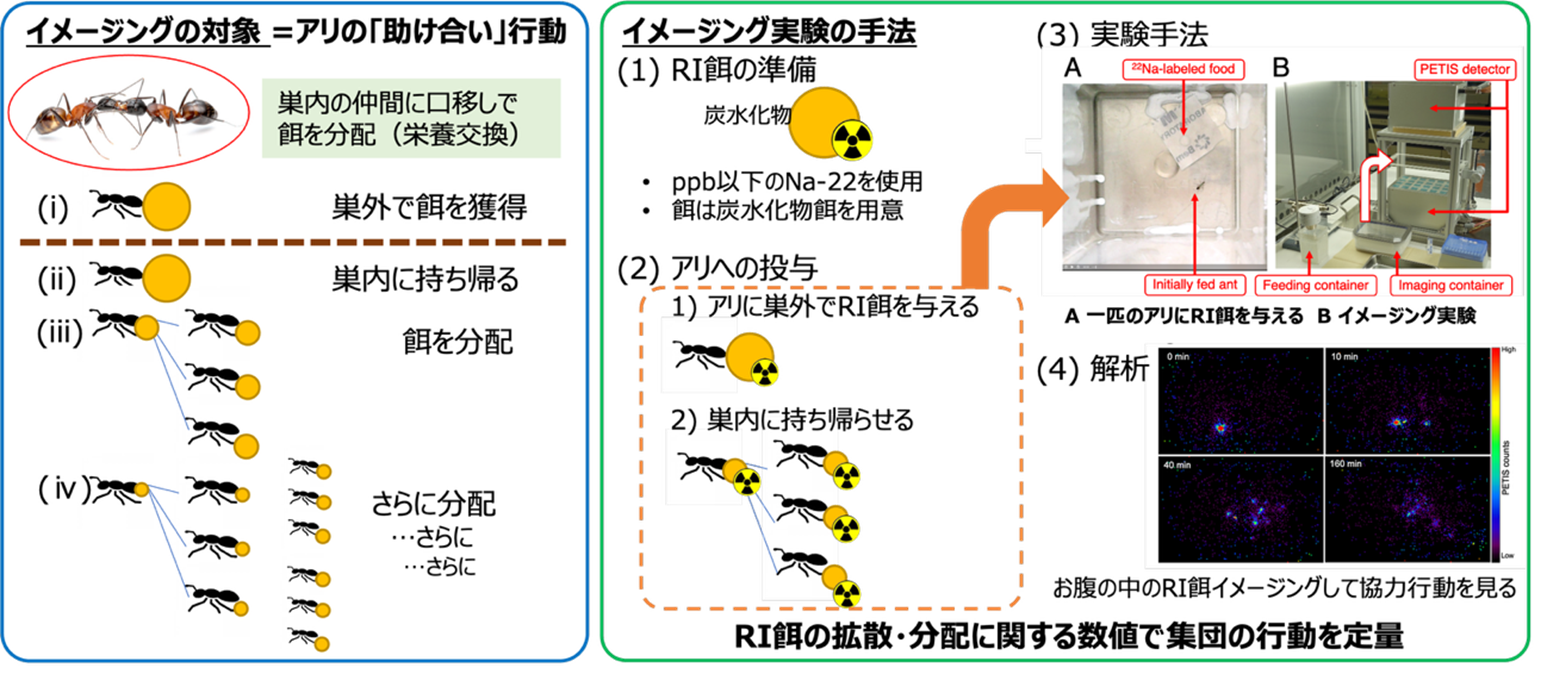
図1 22Naを用いたアリの「助け合い行動」を可視化するRIイメージング実験手法
<関連情報>
高感度陽電子イメージングにより、アリの集団における短期的な食物分布パターンが明らかになる Highly sensitive positron imaging reveals short-term food distribution patterns in ant groups
Nobuo Suzui,Mitsutaka Yamaguchi,Seiji Higashino,Yong-Gen Yin,Yuta Miyoshi,Ryuichi Suwa,Kazuki Tsuji &bNaoki Kawachi
Scientific Reports Published:26 March 2026
DOI:https://doi.org/10.1038/s41598-026-36930-3
Abstract
Studying food distribution in ant groups is essential for investigating social behavior, offering valuable insights into resource allocation, group dynamics, and environmental adaptation, thereby advancing ecological research. In this work, a highly sensitive and quantitative experimental tool was developed to visualize changes over time in food distribution within ant groups using positron-emitting radionuclides and a radiation imaging system. Food distribution observations within a 100-ant group allowed changes in an index of dispersion for food allocation to be quantified for 3 h. The method’s accuracy was confirmed by cross-checking with the results of a conventional quantification method using a gamma counter. Additionally, we successfully visualized food distribution in a 12-ant group and quantified the amount of food exchanged over a 30-min period. This method can be used to elucidate the mechanisms that control food distribution.