2025-03-27 京都大学
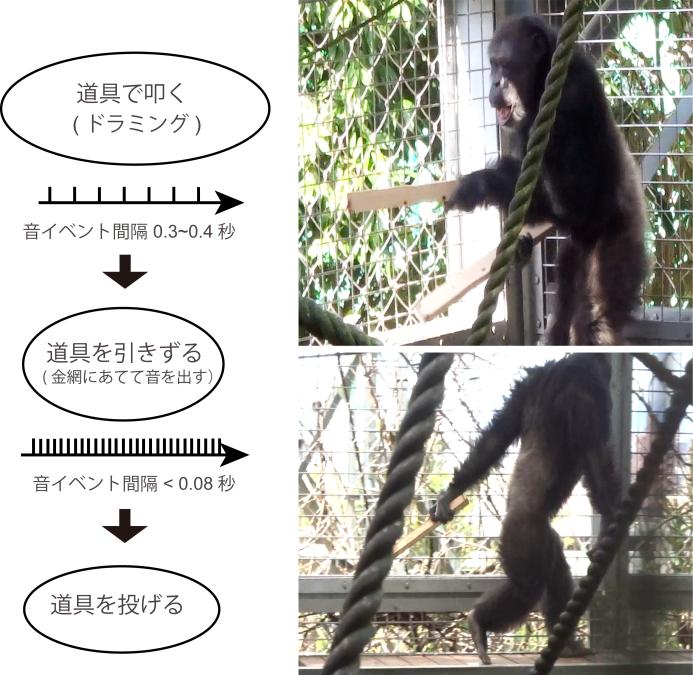
撮影:服部裕子、©京都大学 ヒト行動進化研究センター
<関連情報>
- https://www.kyoto-u.ac.jp/ja/research-news/2026-03-27-0
- https://www.kyoto-u.ac.jp/sites/default/files/2026-03/web_2603_Hattori-17d930e265b26fed37d8d989de2c9122.pdf
- https://nyaspubs.onlinelibrary.wiley.com/doi/10.1111/nyas.70239
飼育下のチンパンジーにおける組み合わせ的な楽器音生成:発声の外在化の進化 Combinatorial Instrumental Sound-Making in a Captive Chimpanzee: Evolution of Vocal Externalization
Yuko Hattori, Pavel Voinov, Makiko Uchikoshi
Annals of the New York Academy of Sciences Published: 25 March 2026
DOI:https://doi.org/10.1111/nyas.70239
ABSTRACT
Instrumental music may have evolved from earlier vocal expressions, gradually expanding into rhythmic sound production using tools. We report a novel case in which a captive male chimpanzee spontaneously produced a structured instrumental display using a self-fabricated tool. The display consisted of combinatorial sequences of rhythmic actions resembling the structure of pant–hoot vocalizations. Transition analyses revealed significant nonrandom transitions from tool-assisted drumming to object dragging, and from dragging to object throwing, and rhythm analyses showed that the drumming patterns were predominantly isochronous. Tool-assisted drumming was less variable than bodily drumming. Notably, facial expressions, including play face and silent bared teeth, were also observed, suggesting emotional engagement and potential social signaling. These findings indicate that emotional expression—usually mediated via vocalizations—can be externalized through instrumental sound. This behavior may provide important insights into evolutionary pathways leading to human musical expression. Our findings also support the hypothesis that music may have originated from affective vocal expression and evolved through multimodal integration of sound-making behaviors. Observations from captive environments, where constraints such as predator avoidance are relaxed, may reveal otherwise-hidden capacities for structured sound production. Our research highlights the evolutionary continuity between primate acoustic displays and the human capacity for music.