2026-03-09 中国科学院(CAS)
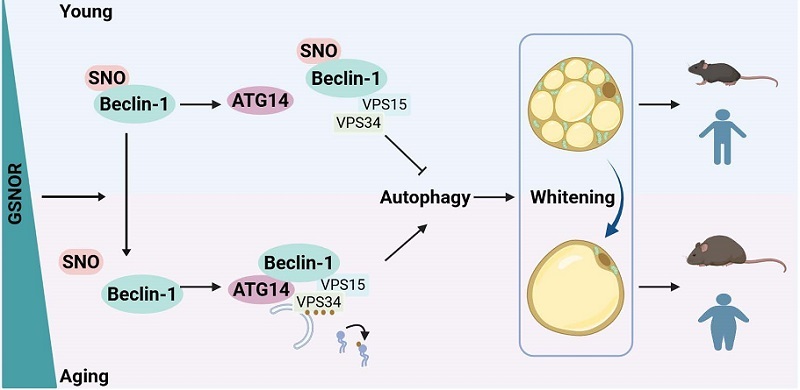
Schematic illustration of the molecular mechanism by which GSNOR promotes autophagy and induces adipose tissue whitening in age-related obesity. (Image by CHEN Chang’s group)
<関連情報>
- https://english.cas.cn/newsroom/research-news/202603/t20260326_1153820.shtml
- https://www.nature.com/articles/s41467-026-69793-3
S-ニトロソグルタチオン還元酵素GSNORは、Beclin-1の脱ニトロソ化を介して脂肪組織の白化を促進することにより、加齢に伴う肥満を引き起こす S-nitrosoglutathione reductase GSNOR drives age-related obesity by promoting adipose tissue whitening through de-nitrosation of Beclin-1
Xinhua Qiao,Ting Xie,Yuying Zhang,Chuanxin Sun,Xuanhao Wu,Yuzhe Chen,Qin Yao,Haoyang Shi,Shilong Li,Hongyu Zhao,Tiepeng Wang,Jiao Meng,Li Zhou,Mutian Niu,Yangxi Hu,Hansong Liu & Chang Chen
Nature Communications Published:23 February 2026
DOI:https://doi.org/10.1038/s41467-026-69793-3 Unedited version
Abstract
Age-related obesity is a growing public health concern linked to various metabolic disorders, yet its underlying mechanisms remain incompletely understood. Here we report that S-nitrosoglutathione reductase (GSNOR), a pivotal denitrosation enzyme, increases in adipose tissue of both male mice and humans from middle-age. GSNOR knockout protects against age-related weight gain and enhances metabolism, whereas adipose-specific GSNOR knock-in mice promotes obesity and metabolic decline. Further investigation reveals that aged GSNOR KO mice maintain higher mitochondrial content and more beige adipocytes, whereas adipose-specific GSNOR overexpression promotes adipose tissue whitening. Mechanistically, GSNOR denitrosates Beclin-1 at cysteine 351 and mutation of this site (Beclin-1C351A) increases autophagy by enhancing Beclin-1 and ATG14 interaction, thereby accelerating beige-to-white adipocyte conversion. Together, our findings reveal that GSNOR regulates adipose tissue remodeling during aging through Beclin-1 S-nitrosation, pointing to a potential therapeutic target for age-related obesity.