2026-03-30 兵庫県立大学
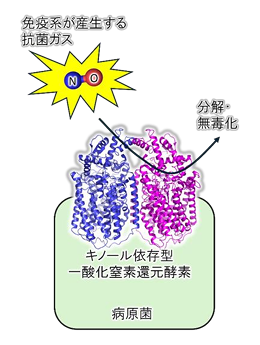
図1 キノール依存型一酸化窒素還元酵素による抗菌ガスの無毒化。
<関連情報>
- https://www.u-hyogo.ac.jp/news/pressrelease/20260330press.html
- https://www.u-hyogo.ac.jp/20260330press.pdf
- https://www.nature.com/articles/s42003-026-09754-0
キノール依存型一酸化窒素還元酵素の二量体形成による活性化の構造基盤 Structural basis of Neisseria meningitidis quinol dependent nitric oxide reductase activation by dimerization
Chai C. Gopalasingam,Haruka Egami,Hideki Shigematsu,Masatora Sakaue,Kouki Fukumoto,Christoph Gerle,Masaki Yamamoto,Yoshitsugu Shiro,Kazumasa Muramoto & Takehiko Tosha
Communications Biology Published:27 March 2026
DOI:https://doi.org/10.1038/s42003-026-09754-0
Abstract
In all kingdoms of life, the regulation of membrane-bound enzyme function via oligomerization is a fundamental aspect of cell physiology. Often, the mechanistic role of oligomerization is unclear, due to a lack of structure-function comparisons between constituent forms of the enzyme. Here, we elucidate the structural underpinnings of enzyme regulation and oligomerization in the quinol-dependent nitric oxide reductase (qNOR) from Neisseria meningitidis, by high-resolution structural analyses of the less active monomeric form (2.25 Å) and the highly active dimeric form (1.89 Å). The comparison revealed that broad helical flexibility near the dimer interface of the monomer causes a conformational change in a critical amino acid near the active site, located apart from the dimer interface. We demonstrate that the crosstalk between the dimer interface and catalytic site in qNOR allows enhanced activation of the enzyme via dimerization. Given Neisseria meningitidis’ dependence on qNOR to detoxify the host’s immune response of nitric oxide, our results pave a way for new strategies to combat bacterial infections, via the inactivation of qNOR by monomerization. More broadly, this provides new insights into the role of membrane protein oligomerization and its influence on regulating activity.