2026-03-30 東京大学
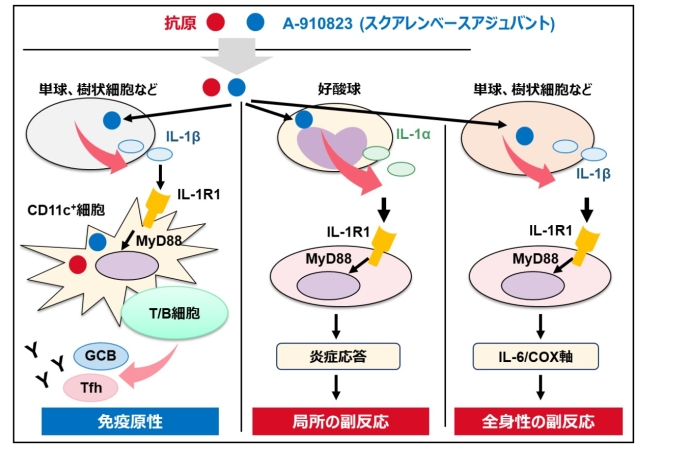
スクアレンベースアジュバントによる免疫原性および副反応誘導機序の概略図
<関連情報>
- https://www.ims.u-tokyo.ac.jp/imsut/jp/about/press/page_00385.html
- https://www.nature.com/articles/s41541-026-01420-0
IL-1は、細胞型特異的な方法でスクアレンベースのアジュバントの有効性と反応原性を明確にする IL-1 delineates squalene-based adjuvant efficacy and reactogenicity in a cell-type-specific manner
Yuya Yoshioka,Anri Nishinaka-Yoshioka,Kouji Kobiyama,Tomoya Hayashi,Yujiro Kidani,Yosuke Yanagida,Junpei Kasahara,
Kenichiro Tsujii,Yoshiji Asaoka,Norikazu Kuroda,Akira Kugimiya,Hiroaki Osawa,Akimasa Yoshimura,Motoyasu Onishi,
Takayuki Nakagawa,Satoru Ishida,Shinya Omoto,Morio Nagira,Cevayir Coban & Ken J. Ishii
npj Vaccines Published:30 March 2026
DOI:https://doi.org/10.1038/s41541-026-01420-0
Abstract
Squalene-based adjuvants are widely utilized in various vaccines because of their effectiveness in enhancing immune responses. Among these, A-910823 and AS03 are recognized squalene-based adjuvants containing α-tocopherol. Although α-tocopherol-containing squalene-based adjuvants are known to enhance humoral immune responses and inflammatory cytokine production, their underlying mechanisms remain unclear. Here, we found that A-910823 regulated IL-1 signaling pathway gene expression and IL-1α and IL-1β protein expressions in an α-tocopherol-dependent manner. While the source of IL-1α was mainly from eosinophils, IL-1β was from a wide range of myeloid cells. Mechanistically, IL-1β/CD11c+ cell-IL-1R1/MyD88 axis mediated adjuvant efficacy, however, systemic reactogenicity was induced by the IL-1β/IL-1R1/MyD88/IL-6/cyclooxygenase 2 axis, which was an unexpectedly distinct mechanism from the local reactogenicity that was mediated by the eosinophil-derived IL-1α/IL-1R1/MyD88 axis. These findings demonstrate that adjuvant efficacy and reactogenicity are regulated by distinct pathways and cell types. This study thus provides novel insights into the mechanisms of adjuvants, providing valuable information to support the future development of effective and safe vaccines.