2026-03-13 基礎生物学研究所,生命創成探究センター
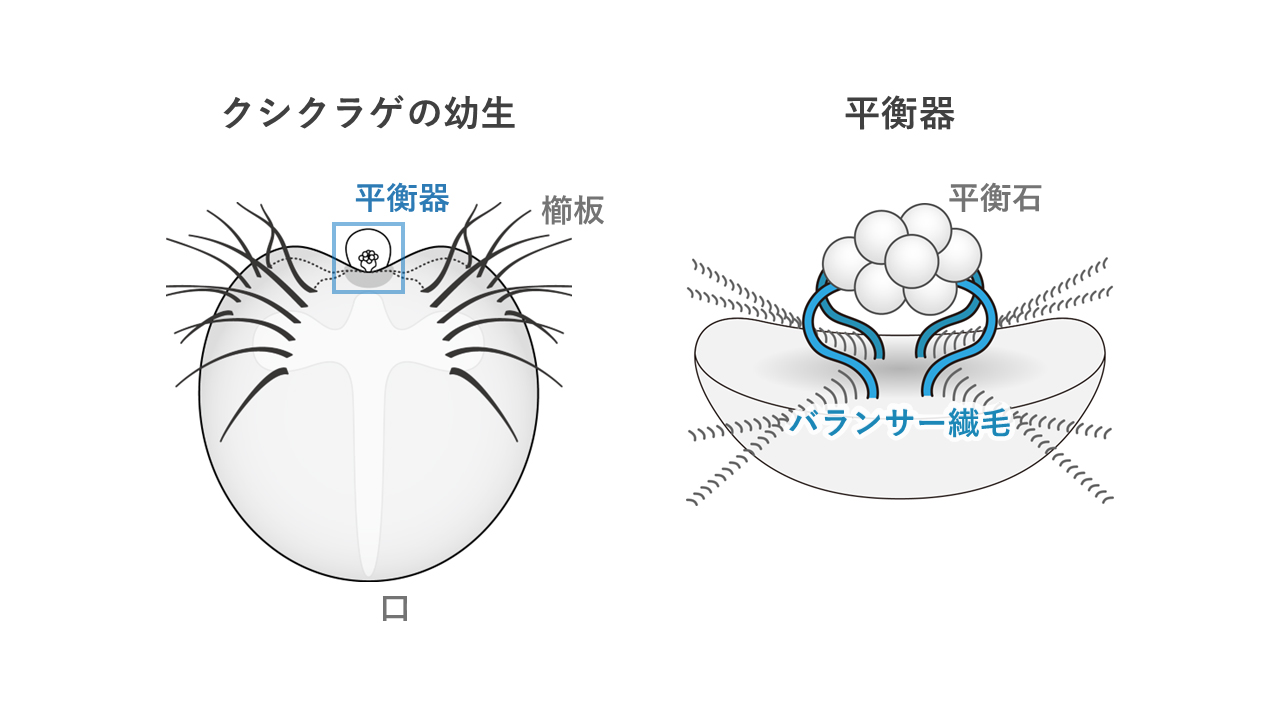
図1.左:クシクラゲの幼生の模式図。口とは反対側にある平衡器を青い四角で囲っている。体の表面には櫛板が生えている。右:平衡器の模式図。平衡石を支えている「バランサー繊毛」が青色で示してある。小さな繊毛がバランサー繊毛から放射状に並んでおり、櫛板へとつながっている。
<関連情報>
有櫛動物の平衡胞の神経コネクトーム Neural connectome of the ctenophore statocyst
Kei Jokura ,Sanja Jasek,Lara Niederhaus,Pawel Burkhardt,Gáspár Jékely
eLife Published:Feb 17, 2026
DOI:https://doi.org/10.7554/eLife.108420.3
Abstract
Ctenophores possess a unique gravity receptor (statocyst) in their aboral organ formed by four clusters of ciliated balancer cells that collectively support a statolith. During reorientation, differential loads on the balancer cilia lead to altered beating of the ciliated comb rows to elicit turns. To study the neural bases of gravity sensing, we used volume electron microscopy to image the aboral organ of the ctenophore Mnemiopsis leidyi. We reconstructed 1011 cells, including syncytial neurons that form a nerve net. The syncytial neurons synapse on the balancer cells and also form reciprocal connections with the bridge cells that span the statocyst. High-speed imaging revealed that balancer cilia beat and arrest in a coordinated manner but with differences between the sagittal and tentacular planes of the animal, reflecting nerve-net organization. Our results suggest a coordinating rather than sensory–motor function for the nerve net and inform our understanding of the diversity of nervous-system organization across animals.