2026-04-10 京都大学
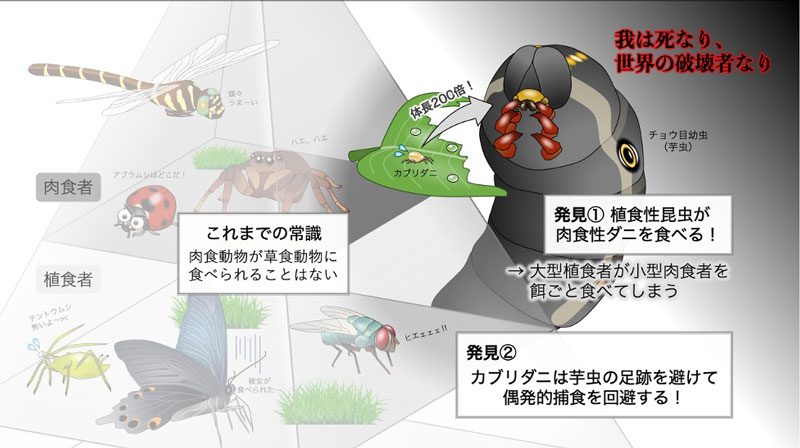
本研究の概要図 ©️ Kinto Shiori
<関連情報>
- https://www.kyoto-u.ac.jp/ja/research-news/2026-04-10-1
- https://www.kyoto-u.ac.jp/sites/default/files/2026-04/web_2604_Kinto-dba0cc5da871a0dc980a67acfee27542.pdf
- https://esajournals.onlinelibrary.wiley.com/doi/10.1002/ecs2.70627
- https://www.nature.com/articles/s41598-023-28861-0
小型捕食者は草食性動物である芋虫の足跡を避けて偶発的捕食を防ぐ Tiny predators avoid herbivorous caterpillar traces to prevent accidental predation
Shiori Kinto, Shuichi Yano
Ecosphere Published: 07 April 2026
DOI:https://doi.org/10.1002/ecs2.70627
Abstract
We report the first example of predators having a strategy to avoid accidental predation by herbivorous insects. The predatory mites Neoseiulus womersleyi and Euseius sojaensis are smaller than 0.5 mm and lay eggs on plant leaf surfaces; thus, their immobile eggs would be incidentally consumed along with leaves by voracious lepidopteran caterpillars. We experimentally demonstrated that eggs of both mite species were preyed upon by tested hawkmoth caterpillars (Theretra oldenlandiae, Theretra japonica) along with leaves. Therefore, the ability to avoid such accidental predation should confer a selective advantage to mites. We further demonstrated that adult females of both mite species avoided laying eggs on leaves with traces of all tested caterpillars (T. oldenlandiae, T. japonica, Papilio xuthus, and Bombyx mori), indicating that eggs may avoid accidental predation by voracious caterpillars that may be nearby. This is the first demonstration of a repellent effect of herbivorous insect traces on carnivores. Considering previous studies showing that spider mites as small as predatory mites also avoid caterpillar traces, the same need to avoid predation by huge caterpillars may have led to the development of the same solutions for both spider mites and predatory mites.
ハダニは同じ草食性動物である芋虫の足跡を避けて偶発的ギルド内捕食を防ぐ Spider mites avoid caterpillar traces to prevent intraguild predation
Shiori Kinto,Toshiharu Akino & Shuichi Yano
Scientific Reports Published:01 February 2023
DOI:https://doi.org/10.1038/s41598-023-28861-0
Abstract
The phytophagous spider mites Tetranychus kanzawai and Tetranychus urticae can be as small as < 0.5 mm; thus, they are often incidentally consumed along with food plant leaves by voracious lepidopteran larvae (hereafter, ‘caterpillars’). Therefore, the ability to avoid such intraguild predation should confer a selective advantage to mites. We experimentally demonstrated that adult females of both mite species avoided settling on food plant leaves with traces of all tested caterpillar species (Bombyx mori, Papilio xuthus, Spodoptera litura and Theretra oldenlandiae). We examined additional interactions using B. mori and T. kanzawai and found that B. mori trace avoidance by T. kanzawai lasted for more than 48 h. Tetranychus kanzawai also avoided B. mori traces on plant stems, along which mites access leaves. Moreover, T. kanzawai avoided acetone extracts of B. mori traces applied to filter paper, indicating that chemical substances of caterpillar traces are responsible for the avoidance. This study is the first demonstration of a repellent effect of herbivore trace chemicals on heterospecific herbivores. Although spider mites have developed resistance against many synthetic pesticides, these results predict that natural compounds simulating caterpillar traces may repel spider mites from agricultural crops.