2026-05-18 カリフォルニア大学リバーサイド校(UCR)
<関連情報>
- https://news.ucr.edu/articles/2026/05/18/what-we-now-know-about-how-smoking-stiffens-lungs
- https://royalsocietypublishing.org/rsif/article/23/238/20250721/481637/Human-lung-parenchyma-tensile-mechanics-and-the
ヒト肺実質:引張力学と喫煙の影響 Human lung parenchyma: tensile mechanics and the effects of smoking
Talyah M. Nelson;Mona Eskandari
Journal of the Royal Society Interface Published:13 May 2026
DOI:https://doi.org/10.1098/rsif.2025.0721
Abstract
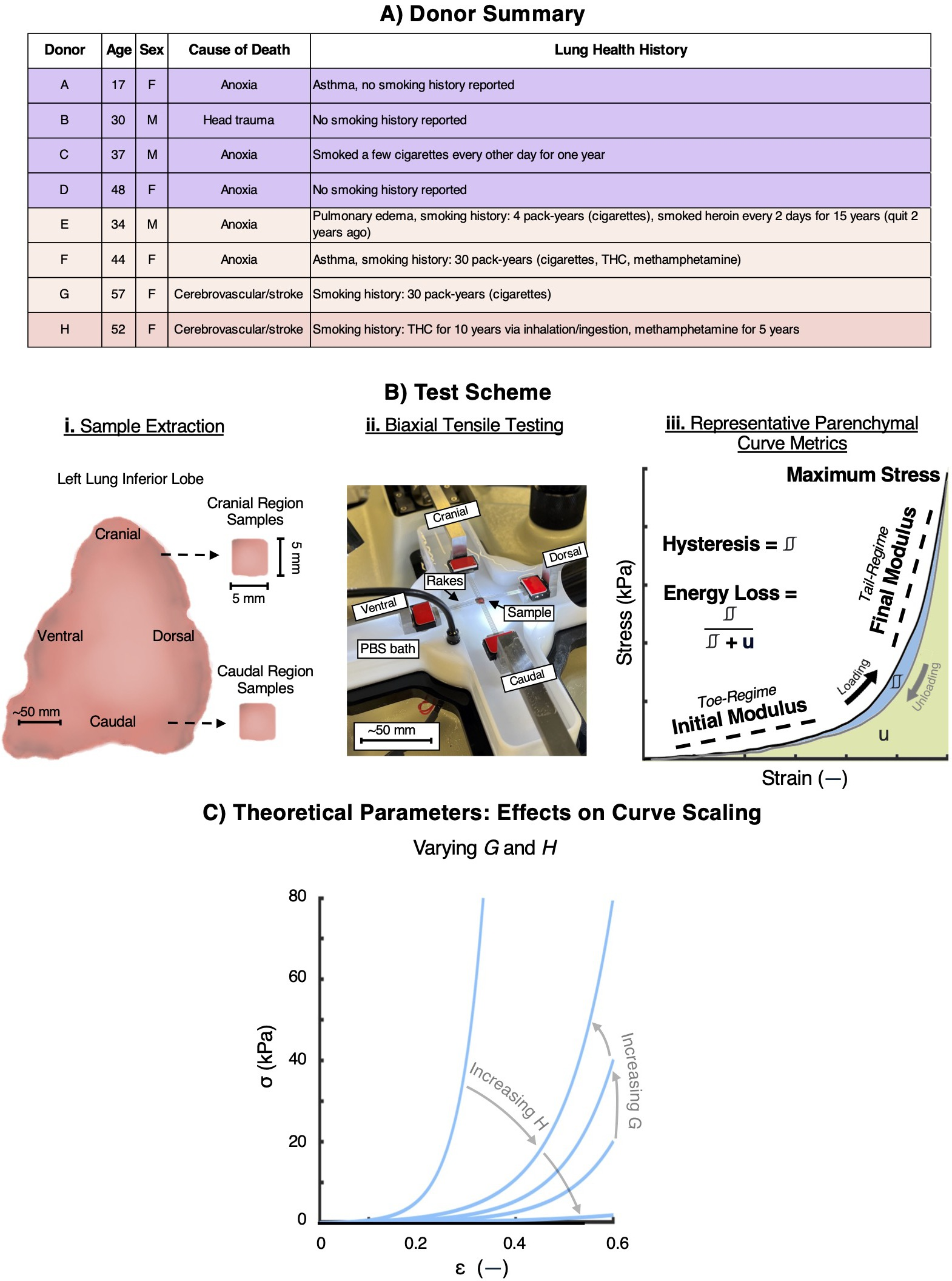
Pulmonary disease is a globally leading cause of morbidity and mortality, largely attributable to the lung’s chronic particulate inhalation. Pervasive environmental hazards and, notably, habitual smoking produce inflammation and damage, consequently changing tissue- and organ-scale mechanical properties. While the parenchyma is regarded as a site of major disease manifestation, the mechanical characterization remains remarkably lacking, and even more rare for human lungs and considerations of material property changes from disease-induced factors, such as smoking. Such limitations hinder our understanding of how basic and pathologically impacted mechanics influence respiratory function. To address this substantial knowledge gap, for the first time, we quantify the tensile elastic and energetic properties of isolated parenchymal regions from eight transplant-eligible or research-designated donor lungs and evaluate smoking effects through an established theoretical model. The parenchyma is generally found to be highly compliant and regionally variant. Smoking demonstrates behaviours akin to fibrosis, with greater final stiffness moduli in smokers (238.6 ± 128.5 kPa) compared with non-smokers (86.5 ± 60.0 kPa). This study critically advances our understanding of human lung mechanics and enables clinically relevant insights by delivering a remarkably valuable database of material property features, notable when considering the current over-reliance on animal models and the scarcity of donor human organs.