2026-05-19 医薬基盤・健康・栄養研究所
<関連情報>
- https://www.nibn.go.jp/pr/press/2026-0519-1006-60.html
- https://www.sciencedirect.com/science/article/pii/S0022395626002426
高齢者のうつ病症状による障害のない生存率:鶴ヶ谷プロジェクトによる歴史的コホート研究 Disability-free survival by symptoms of depression in older adults: a historical cohort study from the Tsurugaya Project
Hiroyuki Fukuhara, Atsushi Hozawa, Naoki Nakaya, Mana Kogure, Haruki Momma, Ryoichi Nagatomi
Journal of Psychiatric Research Available online: 25 April 2026
DOI:https://doi.org/10.1016/j.jpsychires.2026.04.031
Highlights
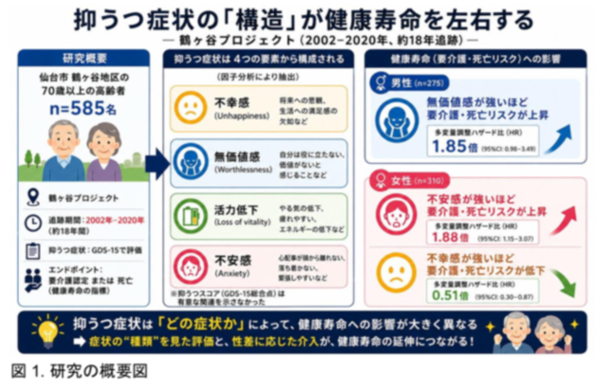
- Factor analysis identified four depressive symptom factors: unhappiness, worthlessness, loss of vitality, and anxiety.
- In men, worthlessness was positively associated with disability or death incidence.
- In women, anxiety was positively associated, whereas unhappiness was inversely associated, with disability or death incidence.
Abstract
Background
Depressive symptoms have been associated with shorter disability-free survival in older adults; however, whether this association differs according to the structure of depressive symptoms remains unclear. We examined the association between the structure of depressive symptoms and risk of disability or death among older men and women in Japan.
Methods
We analyzed 585 individuals who underwent a comprehensive geriatric assessment and agreed to provide information on long-term care insurance. Factor analysis was performed using items from the Geriatric Depression Scale (GDS-15) to extract factors of depressive symptoms. The endpoint was the composite outcome of disability or death, defined as the first certification of any level of care requirement. Associations between the extracted depressive symptom factors and outcomes were examined using a Cox proportional hazards models.
Results
During 18 years of follow-up, 497 incident cases of disability or death occurred. In men, “worthlessness” was positively associated with the incidence of disability or death (hazard ratio [95% confidence intervals], 1.85 [0.98–3.49], P for trend = 0.04) after adjusting for potential covariates. In women, “anxiety” was positively associated with the incidence of disability or death (1.88 [1.15–3.07], P for trend = 0.02), whereas “unhappiness” showed an inverse association with the incidence of disability or death (0.51 [0.30–0.87], P for trend = 0.01).
Conclusions
The association between depressive symptoms and the risk of disability or death in older adults varied according to the structure of depressive symptoms and sex.