2026-07-08 東京科学大学
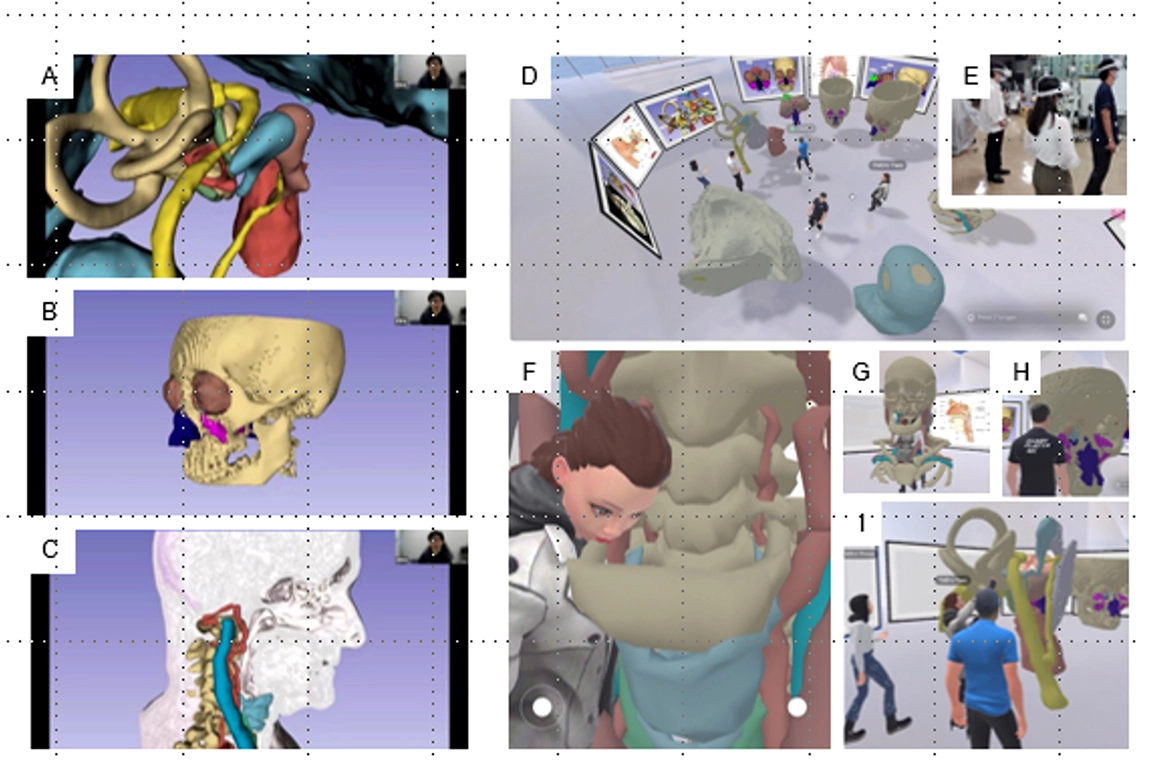
図1. 同一の解剖教材を用いたZoom講義(2D)とメタバースVR講義(3D)の学習場面。
<関連情報>
- https://www.isct.ac.jp/ja/news/sbbjianmd379
- https://anatomypubs.onlinelibrary.wiley.com/doi/10.1002/ase.70277
メタバースベースの仮想現実と頸顔面解剖学における空間学習:学部医学生を対象としたカリキュラム組み込み型比較研究 Metaverse-based virtual reality and spatial learning in cervicofacial anatomy: A curriculum-embedded comparative study in undergraduate medical students
Taku Ito, Hidekazu Kawasaki, Ayame Yamazaki, Yoshimaru Mizoguchi, Kumiko Yamaguchi, Eiji Kaneko, Takeshi Tsutsumi
Anatomical Sciences Education Published: 06 July 2026
DOI:https://doi.org/10.1002/ase.70277
Abstract
To compare a metaverse-based interactive virtual reality (VR) session with a conventional 2D online lecture for learning cervicofacial anatomy. Single-center, curriculum-embedded, nonrandomized comparative study. Fourth-year students attended a Zoom lecture (Conventional, n = 73); sixth-year students completed an interactive VR session using Meta Quest 2 on the Spatial platform (VR, n = 40), delivered in small groups. Immediately after teaching, students completed a 12-item test (9 spatial-relational, 3 factual/topographic). Group differences were analyzed with Welch’s t-tests. VR students scored higher overall than Conventional students (66.0% ± 18.3% vs. 43.6% ± 18.0%; mean difference 22.4 percentage points, 95% CI 15.3–29.6; p < 0.0001), driven by spatial items (68.6% ± 20.1% vs. 40.6% ± 18.9%; difference 28.0, 95% CI 20.3–35.7; p < 0.0001). Factual/topographic scores were similar (58.3% ± 25.9% vs. 52.5% ± 30.4%; difference 6.9, 95% CI −3.4 to 17.2; p = 0.19). Optional free-text comments suggested high engagement and perceived spatial benefits; barriers included headset ergonomics and occasional motion sickness. Metaverse-based interactive VR was associated with substantially better spatial learning than a conventional online lecture, with comparable factual recall. Given the nonrandomized design and small-group VR delivery, future studies should use size-matched randomized designs with baseline testing and richer qualitative methods to isolate immersion effects and evaluate generalizability to other anatomical regions.