2026-06-22 ワシントン大学セントルイス校
<関連情報>
- https://source.washu.edu/2026/06/faster-aging-in-younger-generations-linked-to-rise-in-early-onset-cancer/
- https://www.nature.com/articles/s41591-026-04448-w
生物学的加齢と若年性癌リスクの世代間変化 Biological aging and generational shifts in early-onset cancer risk
Nature Medicine Published:22 June 2026
DOI:https://doi.org/10.1038/s41591-026-04448-w
Abstract
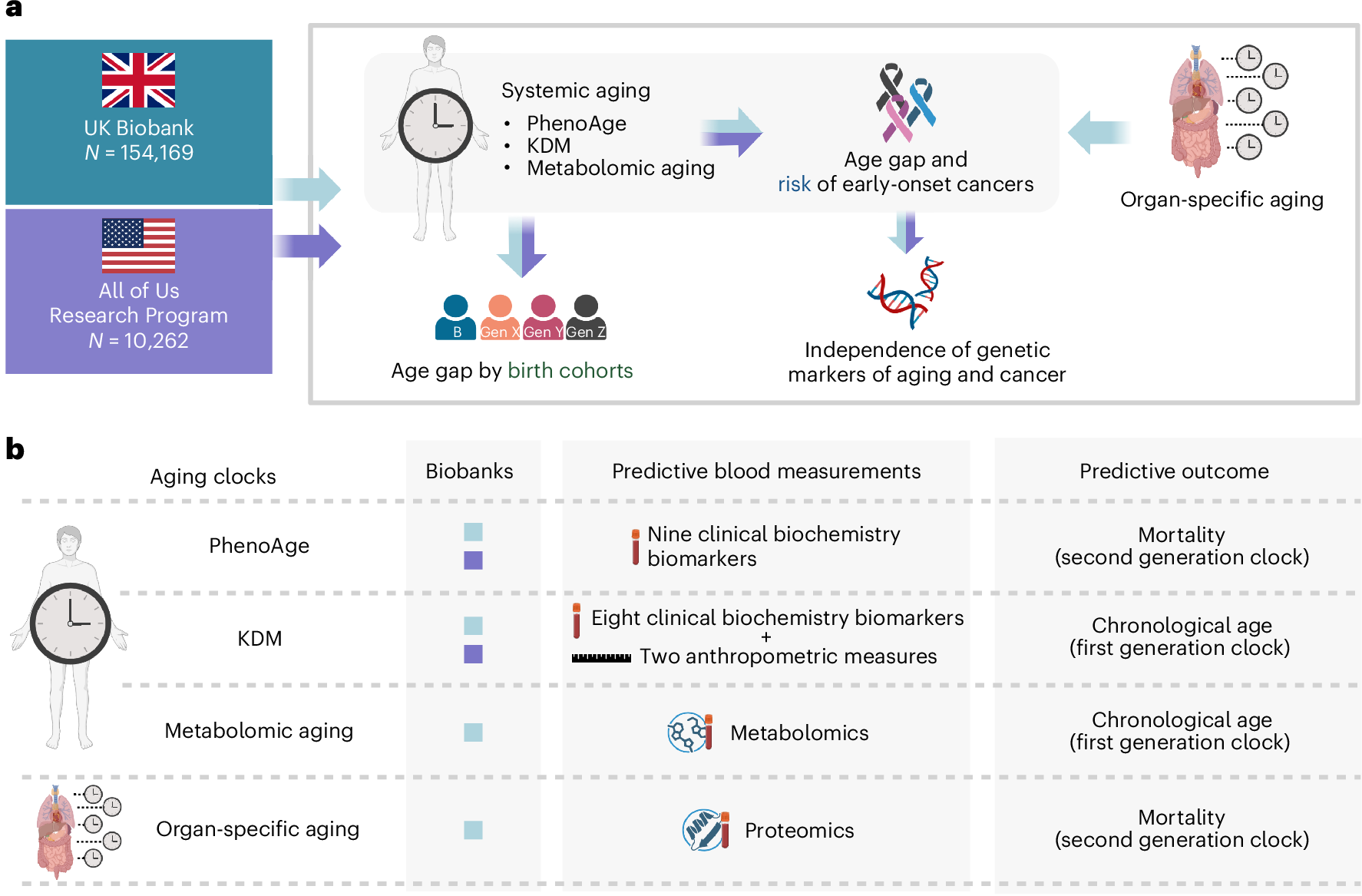
Incidence of early-onset cancer is rising globally in recent generations, which underscores the need to elucidate the influence of emerging generational risk factors. Systemic and organ-specific aging reflects the cumulative impact of exposures and may provide an integrative and complementary approach to understand early-onset cancer risk. Here among 154,169 young adults from the United Kingdom Biobank, systemic aging measured by PhenoAge increased across birth cohorts, with 23% s.d. increase for those born 1965–1974 versus 1950–1954, and was associated with early-onset solid cancer risk (hazard ratio (HR)per s.d. 1.08; 95% confidence interval (CI), 1.03–1.13), driven by lung, gastrointestinal and uterine cancers, independent of genetic risks of aging and cancer. Patterns were consistent using alternative systemic aging measures, including the Klemera–Doubal method-defined age gap and metabolomic-based age gap. These findings were validated partially among 10,262 participants in the United States All of Us Research Program. Proteomics-based organ-specific aging analyses linked immune aging with early-onset lung cancer (HRper s.d. 1.89; CI, 1.20–2.97) and adipose tissue aging to early-onset colorectal cancer (HR 1.60; CI, 1.11–2.32). Greater age gap, reflecting more advanced biological aging relative to chronological age, may serve as a driver associated with risk of early-onset solid cancers, highlighting the importance of uncovering underlying mechanisms to guide effective prevention strategies.