2023-11-22 カリフォルニア工科大学(Caltech)
◆HIVは非常に変異し、抗体や治療法による攻撃から身を守る構造を持つため、治療が難しいウイルスです。特にHIVのエンベロープタンパク質はウイルスの感染プロセスに重要であり、このプロセスを理解することは治療法やワクチンの開発に寄与します。
◆研究者たちは、エンベロープタンパク質の構造がCD4レセプターに結合する際の異なる状態を撮影し、特に1つまたは2つのCD4レセプターにしか結合しない場合、ウイルスが細胞に侵入するために完全に開かないことを明らかにしました。
<関連情報>
- https://www.caltech.edu/about/news/imaging-breakthroughs-provide-insight-into-the-dynamic-architectures-of-hiv-proteins
- https://www.nature.com/articles/s41586-023-06639-8
CD4に結合したHIV-1 Envヘテロ三量体の中間構造 Intermediate conformations of CD4-bound HIV-1 Env heterotrimers
Kim-Marie A. Dam,Chengcheng Fan,Zhi Yang & Pamela J. Bjorkman
Nature Published:22 November 2023
DOI:https://doi.org/10.1038/s41586-023-06639-8
Abstract
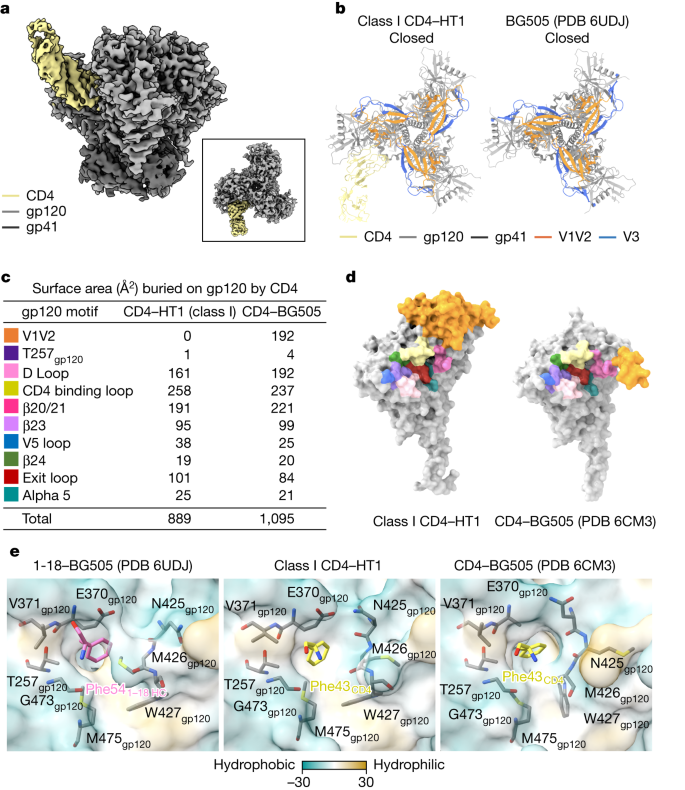
HIV-1 envelope (Env) exhibits distinct conformational changes in response to host receptor (CD4) engagement. Env, a trimer of gp120 and gp41 heterodimers, has been structurally characterized in a closed, prefusion conformation with closely associated gp120s and coreceptor binding sites on gp120 V3 hidden by V1V2 loops1,2,3,4 and in fully saturated CD4-bound open Env conformations with changes including outwardly rotated gp120s and displaced V1V2 loops3,4,5,6,7,8,9. To investigate changes resulting from substoichiometric CD4 binding, we solved single-particle cryo-electron microscopy (cryo-EM) structures of soluble, native-like heterotrimeric Envs bound to one or two CD4 molecules. Most of the Env trimers bound to one CD4 adopted the closed, prefusion Env state, with a minority exhibiting a heterogeneous partially open Env conformation. When bound to two CD4s, the CD4-bound gp120s exhibited an open Env conformation including a four-stranded gp120 bridging sheet and displaced gp120 V1V2 loops that expose the coreceptor sites on V3. The third gp120 adopted an intermediate, occluded-open state10 that showed gp120 outward rotation but maintained the prefusion three-stranded gp120 bridging sheet with only partial V1V2 displacement and V3 exposure. We conclude that most of the engagements with one CD4 molecule were insufficient to stimulate CD4-induced conformational changes, whereas binding two CD4 molecules led to Env opening in CD4-bound protomers only. The substoichiometric CD4-bound soluble Env heterotrimer structures resembled counterparts derived from a cryo-electron tomography study of complexes between virion-bound Envs and membrane-anchored CD4 (ref. 11), validating their physiological relevance. Together, these results illuminate intermediate conformations of HIV-1 Env and illustrate its structural plasticity.