2025-06-17 京都大学
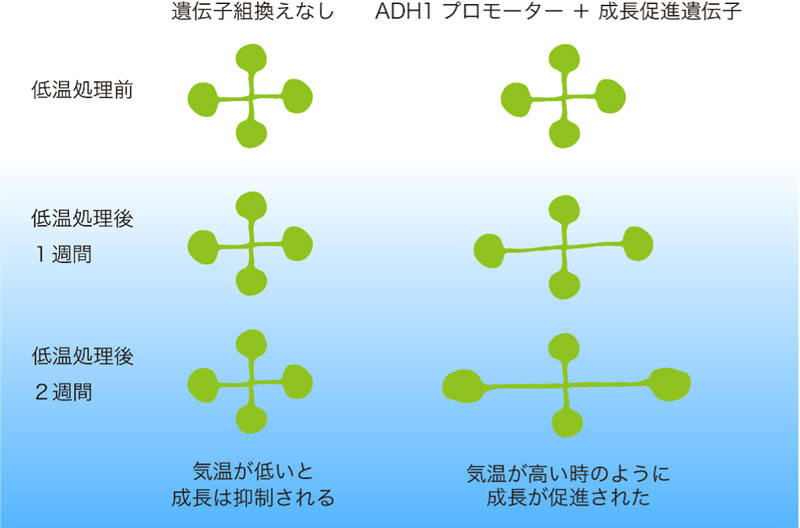 本研究の概要
<関連情報>
- https://www.kyoto-u.ac.jp/ja/research-news/2025-06-17
- https://www.kyoto-u.ac.jp/sites/default/files/2025-06/web_2506_Kudoh-cd81810f287e7f380e70d2b5a3664bfe.pdf
- https://onlinelibrary.wiley.com/doi/10.1111/tpj.70248
植物ADH1プロモーターはH3K27me3関連超長鎖寒冷応答性プロモーターとして働く Plant ADH1 promoter acts as an H3K27me3-associated hyper-long cold-responsive promoter
Hanako Shimizu, Haruki Nishio, Hiroshi Kudoh
The Plant Journal Published: 09 June 2025
DOI:https://doi.org/10.1111/tpj.70248
SUMMARY
Detecting long-term environmental trends is a fundamental requirement for organisms living in fluctuating environments to optimize their physiological and developmental responses. This characteristic depends on long-term memory. However, whether gene promoters alone confer week-scale environmental responses (WERs) and the mechanisms governing the appearance of these responses at different levels of gene expression—including phenotype, protein, histone modification, and mRNA levels—remains unknown. Herein, we performed a genome-wide screening for WER promoters using 1-year-long time-series data of a repressive histone modification, H3K27me3, in the promoter region of Arabidopsis halleri growing in a natural population. We further analyzed the characteristics of the selected WER promoter using the promoter–reporter lines of A. thaliana. H3K27me3 levels in the endogenous A. halleri ALCOHOL DEHYDROGENASE 1 (ADH1) promoter showed WERs, and it responded to 2-week-long low temperatures but not to 1-day-long low temperatures. Moreover, the fusion of the ADH1 promoter to the β-glucuronidase (GUS) reporter gene conferred WER capacity to the GUS protein independently of the mRNA response. The fusion of the coding regions of the FLOWERING LOCUS C and PHYTOCHROME-INTERACTING FACTOR 4 genes to this promoter successfully modified the WERs of the flowering and petiole elongation phenotypes, respectively, directionally opposite to conventional responses. Overall, these results reveal that the A. halleri ADH1 promoter alone can confer WERs at the phenotypic, protein, and H3K27me3 levels, and may potentially confer long-term environmental responsiveness to other genes.