2025-06-27 中国科学院(CAS)
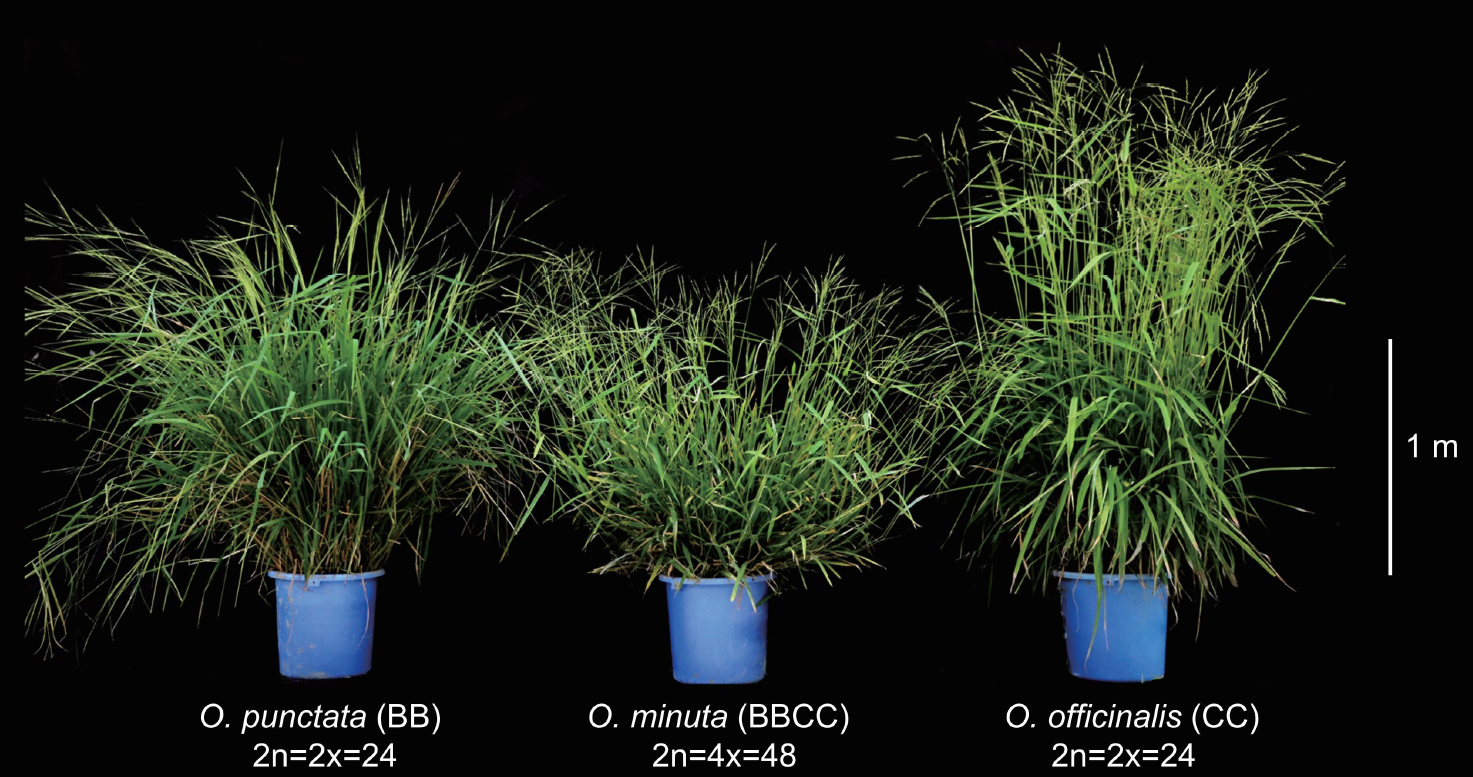
Whole plants of the wild rice allopolyploid Oryza minuta and its two diploid progenitors (Image by WANG Qian)
<関連情報>
- https://english.cas.cn/newsroom/research_news/life/202506/t20250623_1046032.shtml
- https://www.pnas.org/doi/10.1073/pnas.2424854122
野生イネの異質倍数体における二倍体化は、断続的かつ漸進的である Diploidization in a wild rice allopolyploid is both episodic and gradual
Xin Wang, Ning Li, Qian Wang, +18 , and Xin-Hui Zou
Proceedings of the National Academy of Sciences Published:June 26, 2025
DOI:https://doi.org/10.1073/pnas.2424854122
Significance
Diploidization plays a crucial role in overcoming the initial challenges following polyploidy and generating novel variation, thereby contributing to the evolutionary success of angiosperms. However, the search for general “rules” regarding the tempo and mode of diploidization has been difficult. We demonstrate that a population genomic approach which accounts for variation in parental diploid species is critical for understanding polyploid evolution, not only for discrimination of sources of evolutionary variation but also for ascertaining the tempo of change. Our analyses document how the tempo of diploidization in a single species can be both episodic and gradual, depending on the mutation types, which captures the nature of the independence of the heterogeneous genomic processes lumped under “diploidization.”
Abstract
Polyploid organisms evolve from their initial doubled genomic condition through a number of processes collectively termed diploidization, whose tempo and mode remain poorly understood mainly due to the difficulty of discriminating de novo evolution subsequent to polyploidy from variation inherited from progenitors. Here, we generated chromosome-scale genome assemblies for the wild rice allopolyploid Oryza minuta and its two diploid progenitors, Oryza punctata and Oryza officinalis, and employed a population genomic approach to investigate the diploidization process in O. minuta at the sequence and transcriptomic level. We show that this wild rice allopolyploid originated around 0.7 Mya, and during subsequent diploidization, its two subgenomes have retained highly conserved synteny with the genomes of its extant diploid progenitors. This populational approach allowed us to distinguish parental legacy of inherited variation from postpolyploidy evolution, and our analyses revealed that whereas gene fractionation occurred in an early burst, accumulation of transposable elements (TEs) and homoeologous exchanges has been gradual. Patterns of homoeolog expression bias are highly variable across tissues, with no consistent subgenome expression bias. Our assessments of the impact of DNA methylation, TE distribution, and parental legacy on expression patterns provide some support for the TE load theory (the theory that the TE densities in flanking regions surrounding genes strongly influence expression levels), while also illustrating the complexity of transcription regulation.