2025-06-26 中国科学院(CAS)
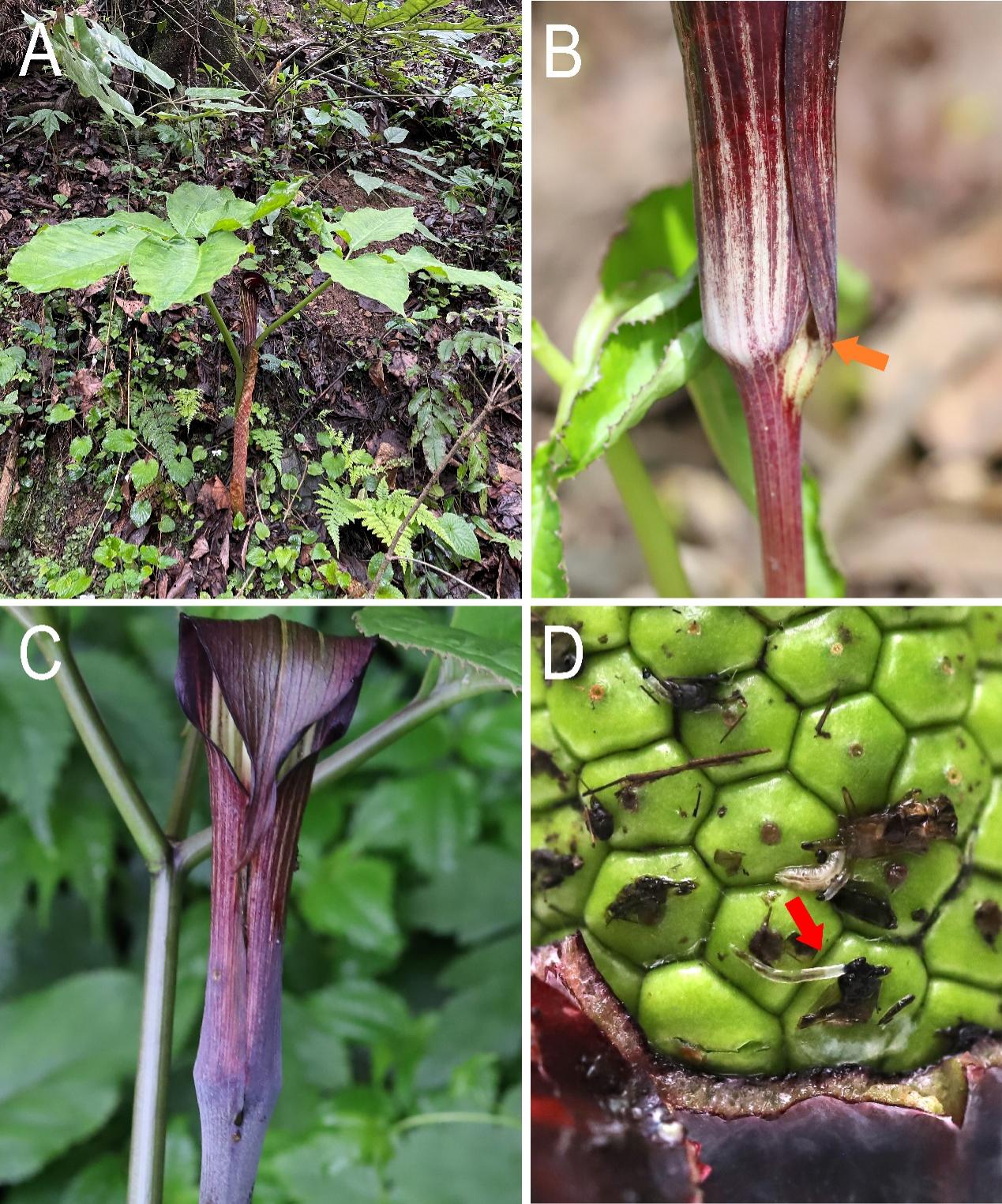
Inflorescence of Arisaema bockii and the fungus gnat larvae feeding on adult corpses. (A) A. bockii in the natural habitat. (B) Male inflorescence of A. bockii; the orange arrow indicates the basal exit hole through which fungus gnats escape after visiting. (C) Female inflorescence of A. bockii, which lacks an exit hole and traps fungus gnats, serving as an oviposition site. (D) Fungus gnat larvae feed on decaying adult carcasses. (Image by HUANG Wen)
中国科学院武漢植物園の研究チームは、マムシグサ属(Arisaema)とキノコバエの間に存在する“隠れた共生関係”を発見しました。Arisaemaの雌花はキノコバエを死に至らせる「罠型花」ですが、ハエはその内部に産卵し、幼虫は死んだ成虫の遺骸を栄養源として成長します。これにより、植物は花粉を媒介される一方、ハエの子孫には繁殖の場を提供するという相互利益の関係が成立。長年謎だった「送粉者を殺す構造が進化的に維持される理由」を説明する新たなメカニズムが示されました。
<関連情報>
- https://english.cas.cn/newsroom/research_news/life/202506/t20250626_1046273.shtml
- https://esajournals.onlinelibrary.wiley.com/doi/10.1002/ecy.70118
腐肉食は、 Arisaemaケトルトラップを子育て場所として利用するキノコバエの幼虫の食物摂取に寄与する
Scavenging contributes to larval food intake in fungus gnats using the Arisaema kettle trap as a brood site
Wen Huang, Xin Li, Qing-Feng Wang, Chun-Feng Yang, Jon Ågren
Ecology Published: 22 May 2025
DOI:https://doi.org/10.1002/ecy.70118