2025-08-08 岡山大学,科学技術振興機構
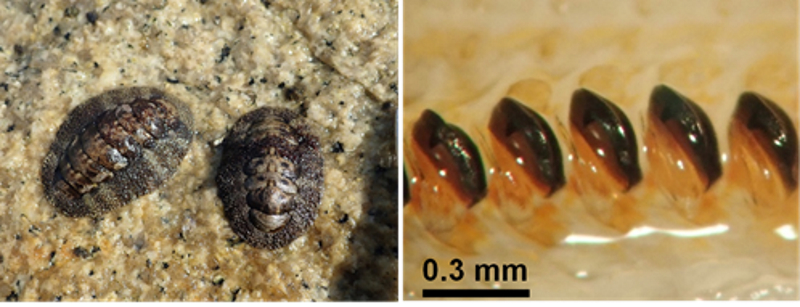
図1. 瀬戸内海のヒザラガイ(左)とその歯(右)
<関連情報>
- https://www.okayama-u.ac.jp/tp/release/release_id1418.html
- https://www.okayama-u.ac.jp/up_load_files/press_r7/press20250808-1.pdf
- https://www.science.org/doi/10.1126/science.adu0043
歯根基質タンパク質1はヒザラガイの歯における酸化鉄の沈着を誘導する Radular teeth matrix protein 1 directs iron oxide deposition in chiton teeth
Michiko Nemoto, Koki Okada, Haruka Akamine, Yuki Odagaki, […] , and Akira Satoh
Science Published:7 Aug 2025
DOI:https://doi.org/10.1126/science.adu0043
Editor’s summary
The major lateral radula teeth of chitons are formed from magnetite and other biominerals in a way that makes them very hard and wear resistant. As the cusps wear out, they are replaced by newly formed teeth from behind. Nemoto et al. expanded on prior studies of these organisms by exploring the molecular mechanism of magnetite biomineralization (see the Perspective by Scheffel). The authors demonstrate that one protein, which they call radular teeth matrix protein 1 (RTMP1), controls iron oxide deposition and differs from other magnetite-precipitating proteins found in magnetotactic bacteria. —Marc S. Lavine
Abstract
Nature builds multiscale mineral structures with impressive mechanical properties through spatially and temporally orchestrated organic-mineral assembly. One example of regulated mineralization is found in hypermineralized and ultrahard magnetic teeth of chiton, which grind on rock to feed on algae. At early stages of tooth formation, iron oxide deposition is controlled using a chiton-specific radular teeth matrix protein 1 (RTMP1), which is transported into teeth through microvilli. RTMP1 spatially and temporally guides and enhances mineralization on chitinous fibers within the tooth, providing a hard, tough, and strong architecture that enables the organism to perform repetitive abrasive events to survive.