2025-08-15 中国科学院(CAS)
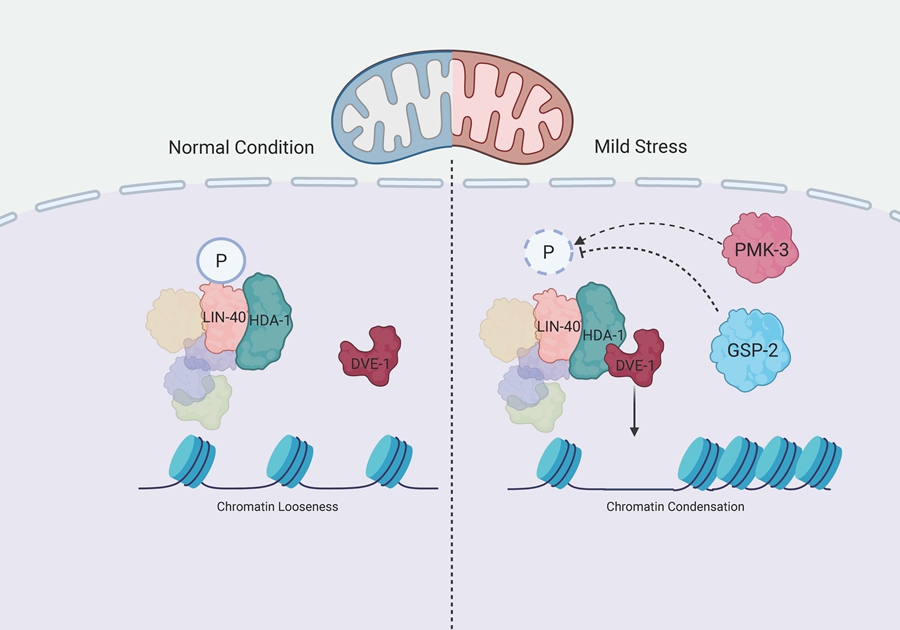
The model of LIN-40 sensing mitochondrial stress via phosphorylation of T654 (Image by IGDB)
<関連情報>
- https://english.cas.cn/newsroom/research_news/life/202508/t20250822_1051207.shtml
- https://link.springer.com/article/10.1007/s11427-025-2954-3
ミトコンドリアストレスは、NuRDコンポーネントLIN-40のリン酸化調節を介してクロマチンリモデルリングと長寿を調整する Mitochondrial stress orchestrates chromatin remodeling and longevity via phosphoregulation of the NuRD component LIN-40
Jun Zhou,Di Zhu,Yibing Wang,Zilun Wang,Ning Zhang,Xiahe Huang,Yiqian Zhang,Yingchun Wang,Xueying Wu & Ye Tian
Science China Life Sciences Published:13 August 2025
DOI:https://doi.org/10.1007/s11427-025-2954-3
Abstract
Mitochondrial dysfunction is a hallmark of aging that elicits adaptive nuclear responses, yet how chromatin remodeling is coordinated under stress remains unclear. Here, we uncover a phosphorylation-dependent mechanism by which mitochondrial stress regulates the activity of the NuRD (nucleosome remodeling and deacetylase) complex via LIN-40, the Caenorhabditis elegans homolog of mammalian MTA proteins. Mitochondrial stress triggers dephosphorylation of LIN-40, enhancing its interaction with the transcription factor DVE-1 to activate the mitochondrial unfolded protein response (UPRmt) and chromatin remodeling. Phosphorylation of LIN-40 is mediated by p38 MAPK/PMK-3 and reversed by PP1c/GSP-2. Furthermore, the LIN-40(T654D) variant abolishes mitochondrial stress-induced lifespan extension. These findings establish a direct link between mitochondrial stress signaling and chromatin remodeling via NuRD, revealing an evolutionarily conserved strategy to coordinate cellular resilience and organismal longevity.