
2024-10-14 ジョージア大学 (UGA)
<関連情報>
- https://news.uga.edu/researchers-separate-plant-growth-and-disease-resistance/
- https://academic.oup.com/plcell/article/36/10/4293/7721303
シロイヌナズナにおけるサリチル酸と成長のトレードオフを、寒冷制御遺伝子の発現を変化させることで切り離すことに成功 Altering cold-regulated gene expression decouples the salicylic acid–growth trade-off in Arabidopsis
María A Ortega, Rhodesia M Celoy, Francisco Chacon, Yinan Yuan, Liang-Jiao Xue, Saurabh P Pandey, MaKenzie R Drowns, Brian H Kvitko, Chung-Jui Tsai
The Plant Cell Published:26 July 2024
DOI:https://doi.org/10.1093/plcell/koae210
Abstract
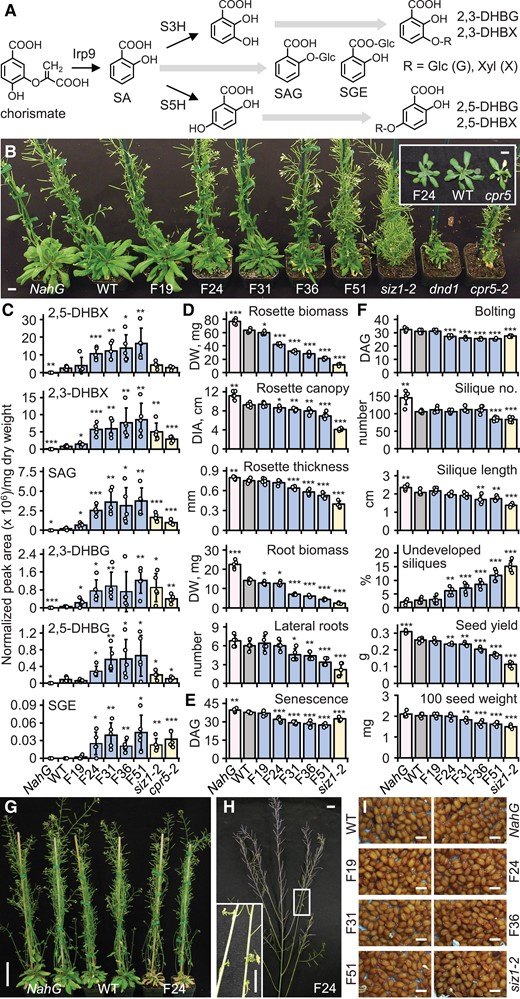
In Arabidopsis (Arabidopsis thaliana), overproduction of salicylic acid (SA) increases disease resistance and abiotic stress tolerance but penalizes growth. This growth–defense trade-off has hindered the adoption of SA-based disease management strategies in agriculture. However, investigation of how SA inhibits plant growth has been challenging because many SA-hyperaccumulating Arabidopsis mutants have developmental defects due to the pleiotropic effects of the underlying genes. Here, we heterologously expressed a bacterial SA synthase gene in Arabidopsis and observed that elevated SA levels decreased plant growth and reduced the expression of cold-regulated (COR) genes in a dose-dependent manner. Growth suppression was exacerbated at below-ambient temperatures. Severing the SA-responsiveness of individual COR genes was sufficient to overcome the growth inhibition caused by elevated SA at ambient and below-ambient temperatures while preserving disease- and abiotic-stress-related benefits. Our results show the potential of decoupling SA-mediated growth and defense trade-offs for improving crop productivity.

