2025-09-18 浙江大学(ZJU)
<関連情報>
- https://www.zju.edu.cn/english/2025/0918/c19573a3083128/page.htm
- https://www.nature.com/articles/s41467-025-58772-9
中国におけるアシネトバクター・バウマニ血流分離株のゲノム疫学と系統動態 Genomic epidemiology and phylodynamics of Acinetobacter baumannii bloodstream isolates in China
Qixia Luo,Mengru Chang,Ping Lu,Qian Guo,Xiaoqing Jiang,Tingting Xiao,Haoyu Zhang,Yingying Ma,Yan Zhang,Wei Yu,Erjia Zhang,Yunbo Chen,Ping Shen,Jinru Ji,Chaoqun Ying,Zhiying Liu,the BRICS Working Group,Huaiqiu Zhu & Yonghong Xiao
Nature Communications Published:14 April 2025
DOI:https://doi.org/10.1038/s41467-025-58772-9
Abstract
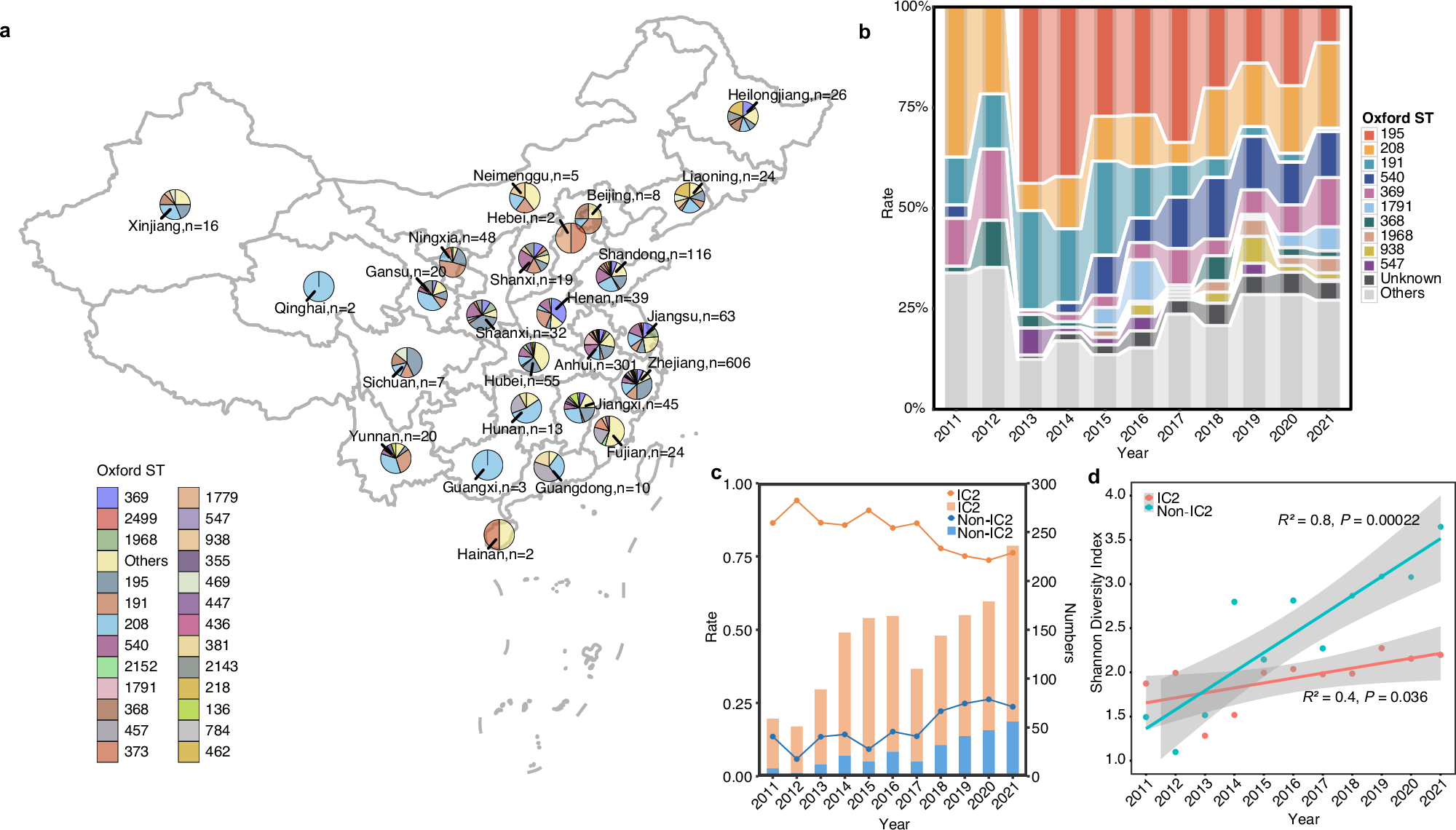
In recent decades, Acinetobacter baumannii has become a major global nosocomial pathogen, with bloodstream infections (BSIs) exhibiting mortality rates exceeding 60% and imposing substantial economic burdens. However, limited large-scale genomic epidemiology has hindered understanding of its population dynamics. Here, we analyzed 1506 non-repetitive BSI-causing A. baumannii isolates from 76 Chinese hospitals over a decade (2011–2021). We identified 149 sequence types (STs) and 101 K-locus types (KLs), revealing increased population diversity. International clone (IC) 2 accounted for 81.74% of isolates, with a notable shift in prevalent STs: ST208 increased while ST191 and ST195 declined, aligning with global trends. ST208 exhibited higher virulence, greater antibiotic resistance, enhanced desiccation tolerance, and more complex transmission patterns compared to ST191 and ST195. Its genomic plasticity drives its adaptation and spread. Using the high-resolution Oxford MLST scheme, this study uncovered greater diversity and genetic factors behind ST208’s rise. A. baumannii is evolving from a low-virulence, multidrug-resistant pathogen to a more virulent one, highlighting the urgent need to address its growing threat. These findings have critical implications for infection control and public health policies.