
2025-11-12 国立精神・神経医療研究センター,電気通信大学
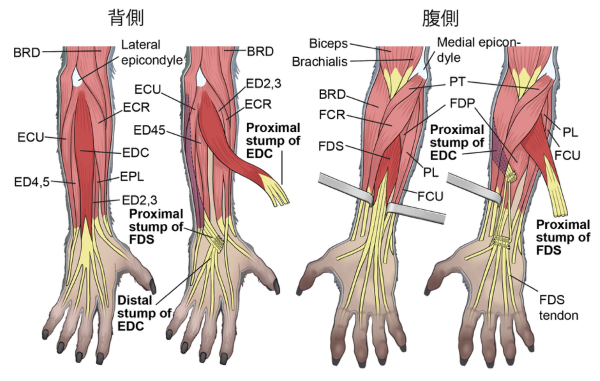
図1:マカクサル前腕の筋解剖と腱移行手術
<関連情報>
- https://www.ncnp.go.jp/topics/detail.php?@uid=1W6dvnjDbRtNSLNG
- https://www.ncnp.go.jp/press_search/images/files/Pr_20251112.pdf
- https://elifesciences.org/reviewed-preprints/108684v1
長期的な筋骨格の再編成の基盤となる多時間スケールの神経適応 Multi-timescale neural adaptation underlying long-term musculoskeletal reorganization
Roland Philipp,Yuki Hara,Naohito Ohta,Naoki Uchida,Tomomichi Oya,Tetsuro Funato,Kazuhiko Seki
eLife Published:November 5, 2025
DOI:https://doi.org/10.7554/eLife.108684.1
Abstract
The central nervous system (CNS) can effectively control body movements despite environmental changes. While much is known about adaptation to external environmental changes, less is known about responses to internal bodily changes. This study investigates how the CNS adapts to long-term alterations in the musculoskeletal system using a tendon transfer model in non-human primates. We surgically relocated finger flexor and extensor muscles to examine how the CNS adapts its strategy for finger movement control by measuring muscle activities during grasping tasks. Two months post-surgery, the monkeys demonstrated significant recovery of grasping function despite the initial disruption. Our findings suggest a two-phase CNS adaptation process: an initial phase enabling function with the transferred muscles, followed by a later phase abolishing this enabled function and restoring a control strategy that, while potentially less conflicted than the maladaptive state, resembled the original pattern, possibly representing a ‘good enough’ solution. These results highlight a multi-phase CNS adaptation process with distinct time constants in response to sudden bodily changes, offering potential insights into understanding and treating movement disorders.
Significance statement
After major changes to the body’s mechanics, the nervous system adapts using strategies on multiple timescales. Our primate tendon transfer study shows that core muscle synergy groupings remain stable, reflecting a default to modular control. However, the activation of these synergies changes dramatically; an initial, rapid ‘swap’ of their timing proves to be maladaptive, impairing motor function. This conflict is only resolved through the gradual development of slower, compensatory strategies over several weeks. This process highlights the fundamental tension the CNS faces when its reliance on stable motor modules conflicts with the need for flexible control, offering insights into neural plasticity and staged rehabilitation.

