2025-11-24 ジョンズ・ホプキンス大学 (JHU)
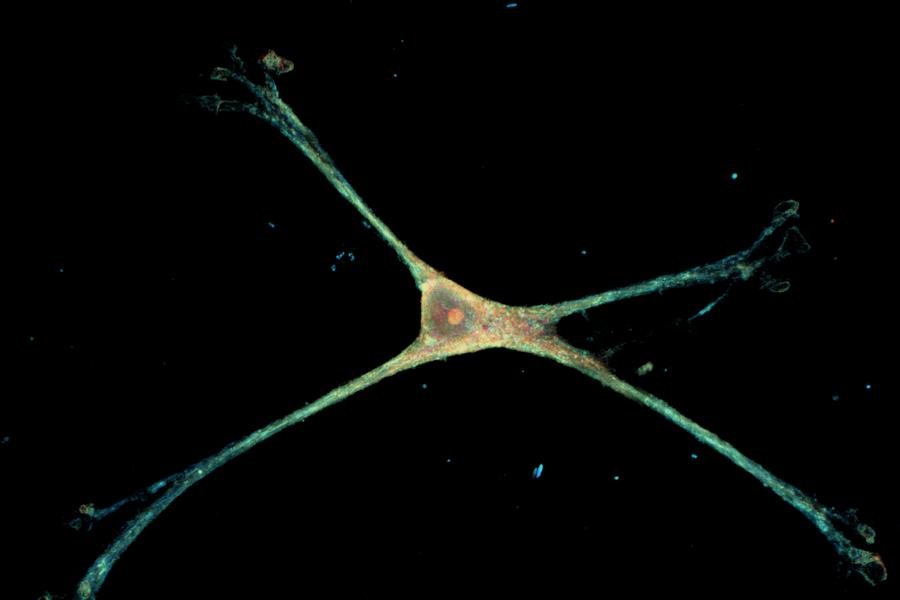 An astrocyte on the novel nanowire platform. Image credit: Johns Hopkins University
<関連情報>
- https://hub.jhu.edu/2025/11/24/nanowire-breakthrough-reveals-elusive-astrocytes/
- https://advanced.onlinelibrary.wiley.com/doi/10.1002/advs.202513424
低コヒーレンスホロトモグラフィーにより、無秩序なガラスナノワイヤ基質が生体内アストロサイト様の形態を形成することが明らかに Disordered Glass Nanowire Substrates Produce in Vivo-Like Astrocyte Morphology Revealed by Low-Coherence Holotomography
Pooja Anantha, Anoushka Gupta, Joo Ho Kim, Emanuela Saracino, Piyush Raj, Ivano Lucarini, Swati Tanwar, Jessica Chen, Luo Gu, Jay Agrawal, Annalisa Convertino, Ishan Barman
Advanced Science Published: 03 November 2025
DOI:https://doi.org/10.1002/advs.202513424
Abstract
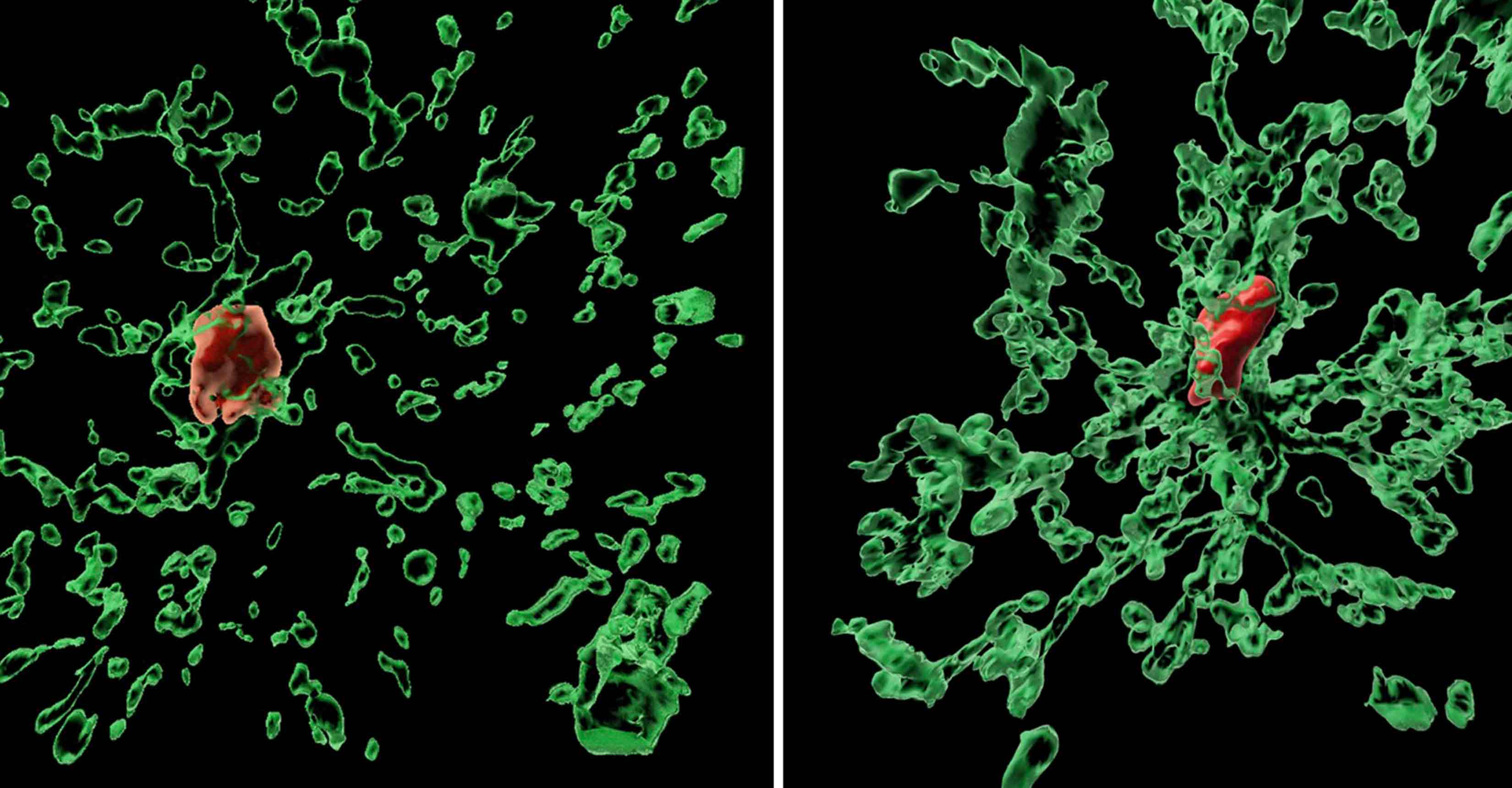
Astrocytes are essential for preserving homeostasis of the central nervous system (CNS). They regulate synaptic activity and interact with the extracellular milieu via their distinctive, star-like morphology. However, there is a lack of detailed understanding of astrocyte morphology, particularly of the in vivo phenotype that is difficult to replicate in vitro and quantify using conventional imaging techniques without exogenous labels. This study marks the first demonstration of low-coherence holotomography (LC-HT), a label-free imaging technique, for 3D quantitative assessment of astrocyte morphology cultured on nanostructured substrates, which typically presents challenges for phase-based imaging. Crucially, it is shown that disordered glass nanowire (NW) substrates can induce in vivo-like astrocyte morphology in cultured rat cortical astrocytes. Compared to traditional glass substrates, astrocytes grown on disordered glass NWs substrates exhibit enhanced process branching and greater total arbor length – features typically observed in their natural, in vivo state of advanced maturation. By combining disordered glass NW substrates with LC-HT, the approach uniquely enables high-fidelity, label-free visualization of complex astrocytic morphologies, providing a powerful platform to study how nanoscale environmental cues shape astrocyte development.