2025-11-14 中国科学院(CAS)
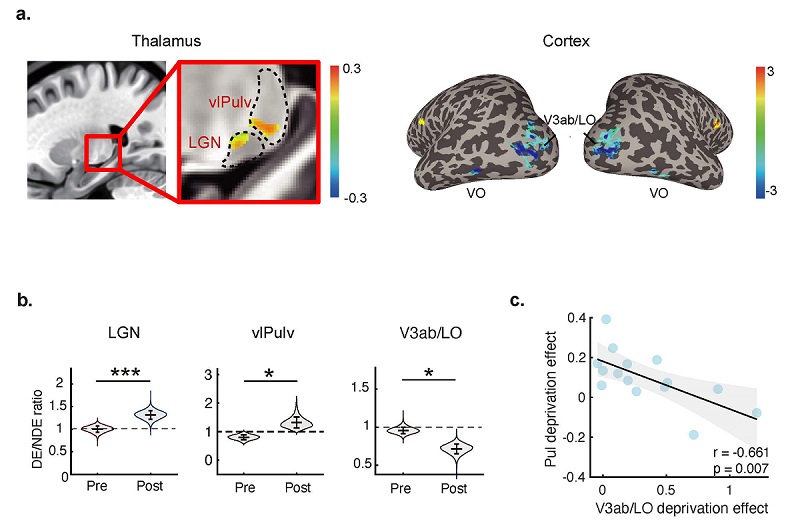
Two opposing but complementary mechanisms of ocular dominance plasticity in the visual thalamus and cortex (Image by ZHANG Peng’s group)
<関連情報>
- https://english.cas.cn/newsroom/research-news/202602/t20260210_1150463.shtml
- https://www.nature.com/articles/s42003-025-08914-y
相反しながらも補完的な2つの眼優位性可塑性:視床は弱いチャネルを強化し、高次皮質は強い信号を聴く Two opposing yet complementary ocular dominance plasticities: thalamus strengthens the weak channel while higher cortex listens to the strong signal
Yazhu Qian,Zhouyuan Sun,Yizhi Wang,Yige Gao,Chencan Qian,Jiawei Zhou & Peng Zhang
Communications Biology Published:11 November 2025
DOI:https://doi.org/10.1038/s42003-025-08914-y
Abstract
Neural mechanisms of ocular dominance plasticity in the adult brain remain elusive. Using high-resolution functional magnetic resonance imaging (fMRI) at 7 T, we investigated ocular dominance plasticity in the visual thalamus and extrastriate visual cortices in response to monocular contrast deprivation (MCD) in human adults. Short-term (3 hours) MCD enhanced the sensitivity of the deprived eye (DE) relative to the non-deprived eye (NDE) in the lateral geniculate nucleus and the ventrolateral pulvinar of the thalamus. Compared to the NDE, the DE became more sensitive in contrast detection and more dominant in binocular combination. On the other hand, MCD reduced DE relative to NDE sensitivity in extrastriate cortices, and DE relative to NDE performance in 3-D shape perception. These findings demonstrate that a homeostatic mechanism in the visual thalamus concurrently operates with a Hebbian-like mechanism in extrastriate cortices to rapidly and adaptively adjust interocular balance to disrupted binocular input.