2025-12-25 東京理科大学
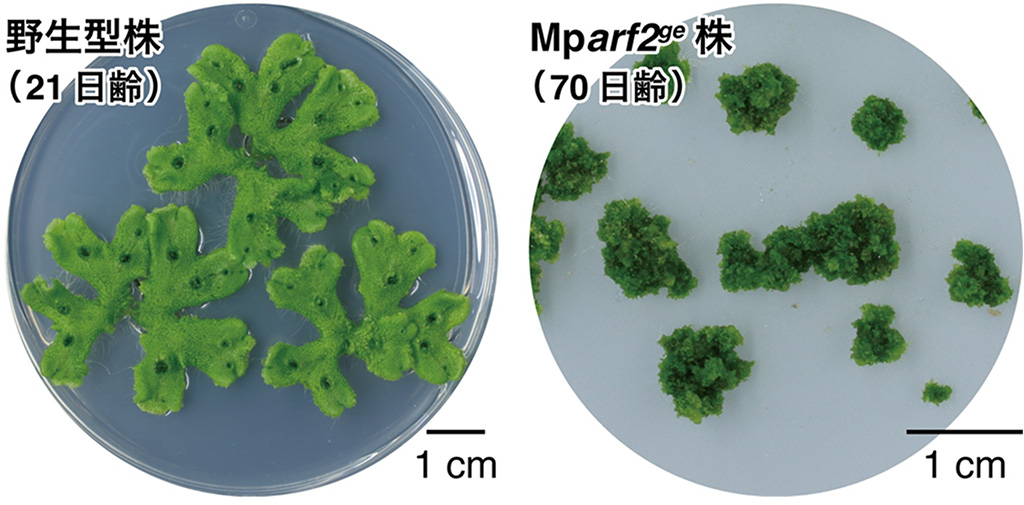
図1 ゼニゴケの野生型株とMpARF2遺伝子を破壊したMparf2ge株
<関連情報>
- https://www.tus.ac.jp/today/archive/20251225_4712.html
- https://www.cell.com/current-biology/abstract/S0960-9822(25)01483-6
Bクラスのオーキシン応答因子MpARF2は自由生活植物配偶体の分裂組織の組織化に必須である The B-class auxin response factor MpARF2 is essential for meristem organization in free-living plant gametophytes
Eduardo Flores-Sandoval ∙ Hidemasa Suzuki ∙ Jessica A. Lazner ∙ … ∙ Takayuki Kohchi ∙ Ryuichi Nishihama ∙ John L. Bowman
Current Biology Published:December 5, 2025
DOI:https://doi.org/10.1016/j.cub.2025.11.015
Highlights
- The auxin response factor MpARF2 determines totipotency in Marchantia
- MpARF2 promotes stem cell identity by creating a low-auxin-response environment
- A- and B-ARFs competitively control auxin biosynthesis to form a meristem organizer
- Meristematic auxin is actively exported by MpPIN1 to promote distal organogenesis
Summary
Land plants (embryophytes) are multicellular eukaryotes with a remarkable capacity to grow continuously during their life span. They achieve this by maintaining a reservoir of pluripotent stem cells in their meristems. In embryophytes, including both bryophytes and tracheophytes, the haploid gametophytic generation is inferred to be ancestrally free living. Gametophyte meristems are sites of auxin biosynthesis, but auxin promotes differentiation, and conversely, a lack of auxin results in the loss of differentiation. We report that in the liverwort Marchantia polymorpha, pluripotent stem cells are protected from auxin-mediated differentiation by the single B-class auxin response factor (MpARF2), an embryophyte-specific gene that antagonizes auxin responses. We describe the critical role of MpARF2 in meristem establishment and maintenance using reporter lines, loss- and gain-of-function alleles, and gene-interaction experiments. Mparf2 knockdown and knockout alleles, respectively, fail to maintain and form a functional meristem across developmental transitions, while overexpression of MpARF2 is sufficient to create additional meristems in dormant gemmae. Despite being an auxin-signaling antagonist, MpARF2 positively regulates auxin production by activating a YUCCA (MpYUC2) auxin biosynthetic enzyme in stem cells. Conversely, auxin responses mediated by the single A-ARF (MpARF1) antagonize both auxin production and MpARF2 expression in differentiating neighbor cells, creating a multicellular incoherent feedforward loop that limits meristem size. We propose that MpARF2 and auxin form a meristem organizer—modulating auxin insensitivity at the site of auxin production while providing signaling information to surrounding differentiating cells—and that this organizer was critical for the emergence of indeterminate growth in the ancestral embryophyte.