2026-01-16 早稲田大学睡眠研究所
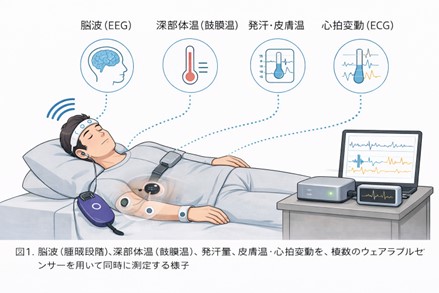
図1 睡眠中の生理指標を同時に測定する模式図
<関連情報>
ウェアラブルセンサーを用いた遠赤外線放射衣服の睡眠、体温調節、自律神経機能に対する生理学的影響の評価 Physiological Effects of Far-Infrared-Emitting Garments on Sleep, Thermoregulation, and Autonomic Function Assessed Using Wearable Sensors
Masaki Nishida,Taku Nishii,Shutaro Suyama and Sumi Youn
Sensors Published: 14 January 2026
DOI:https://doi.org/10.3390/s26020550
Highlights
What are the main findings?
- A multimodal wearable sensing system enabled simultaneous evaluation of sleep architecture, thermoregulation, and autonomic activity under far-infrared (FIR) and control garment conditions.
- FIR garments modestly enhanced nocturnal heat dissipation, reflected by lower tympanic temperature and reduced sweating during the mid-sleep period.
- The proportion of rapid eye movement (REM) sleep increased without changes in total sleep time, indicating a redistribution of sleep stages under altered thermal conditions.
What is the implication of the main findings?
- These findings support the physiological feasibility of assessing functional sleepwear using integrated measures of thermal regulation and autonomic activity.
- Multimodal wearable sensing provides a useful framework for objectively evaluating subtle sleep-related effects of textile-based interventions.
Abstract
Far-infrared (FIR)-emitting textiles are increasingly used in sleepwear; however, their influence on sleep physiology has not been comprehensively evaluated with multi-modal wearable sensing. This randomized, double-blind, placebo-controlled crossover study examined whether FIR-emitting garments modulate nocturnal thermoregulation, autonomic activity, and sleep architecture. Fifteen healthy young men completed two overnight laboratory sleep sessions wearing either FIR-emitting garments or visually matched polyester controls. Tympanic membrane temperature (TMT), sweating rate, skin temperature, and humidity were continuously monitored using wearable sensors, and sleep stages and heart rate variability (HRV) were assessed using validated portable systems. Compared with control garments, FIR garments produced consistently lower TMT across the night (p = 0.004) and reduced mid-sleep sweating (condition × time interaction: p = 0.026). The proportion of rapid eye movement (REM) sleep was higher in the FIR condition (22.2% ± 6.5% vs. 18.6% ± 6.5%, p = 0.027), despite no changes in total sleep time or sleep efficiency. A transient increase in low-frequency power during early sleep (p = 0.027) suggested baroreflex-related thermal adjustments without sympathetic activation. These findings indicate that FIR-emitting garments facilitate mild nocturnal heat dissipation and support REM expression, demonstrating their potential as a passive intervention to improve sleep-related thermal environments.