2026-02-11 ノースウェスタン大学
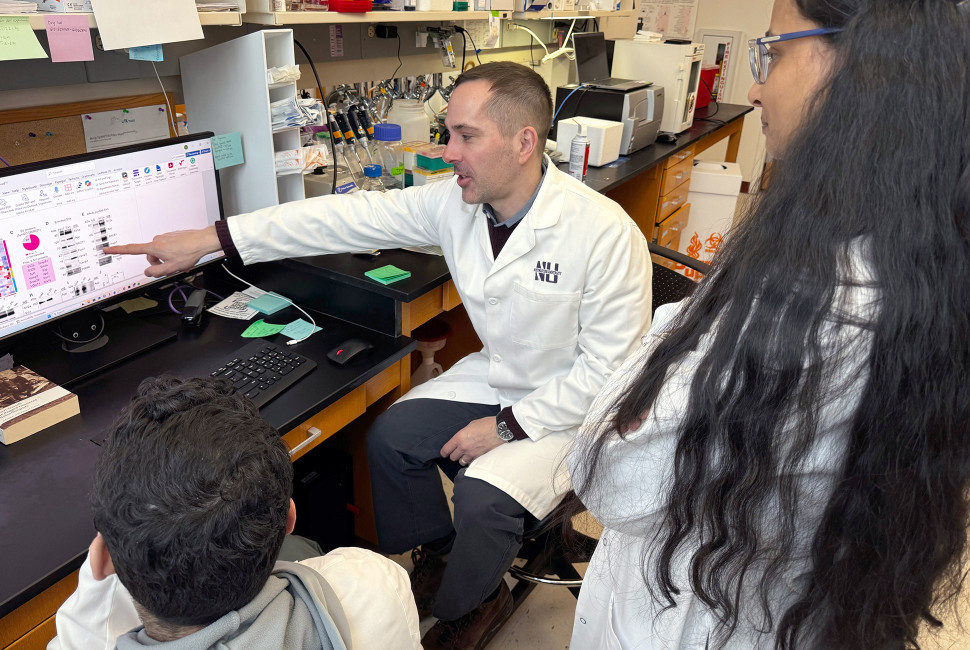
In a new study, Northwestern scientists have pinpointed when and where toxic proteins accumulate in the brains of Alzheimer’s patients and discovered that a decades-old drug can stop that process before it begins. Above, corresponding author Jeffrey Savas talks to members of his lab.
<関連情報>
- https://news.northwestern.edu/stories/2026/02/common-anti-seizure-drug-prevents-alzheimers-plaques-from-forming
- https://www.science.org/doi/10.1126/scitranslmed.adp3984
レベチラセタムはアルツハイマー病モデルにおいて、SV2a依存性のAPP処理調節を介してAβ産生を阻害する Levetiracetam prevents Aβ production through SV2a-dependent modulation of APP processing in Alzheimer’s disease models
Nalini R. Rao, Ivan Santiago-Marrero, Olivia DeGulis, Toshihiro Nomura, […] , and Jeffrey N. Savas
Science Translational Medicine Published:11 Feb 2026
DOI:https://doi.org/10.1126/scitranslmed.adp3984
Editor’s summary
The accumulation of Aβ peptides in presynaptic terminals contributes to synaptic dysfunction in Alzheimer’s disease (AD). The antiepileptic, synaptic vesicle (SV) glycoprotein 2A–binding drug levetiracetam (Lev) has shown promise for the treatment of AD, potentially by targeting synaptic dysfunction, but the exact mechanism of action of Lev remains elusive. Here, Rao et al. used cell and mouse models of Aβ pathology and found that impaired synaptic proteostasis led to an accumulation of presynaptic proteins involved in SV cycling. Lev administration inhibited amyloidogenic proteolytic processing and the accumulation of presynaptic proteins in vitro and in vivo. Brains from patients with Down syndrome also displayed presynaptic protein accumulation before the occurrence of substantial Aβ pathology, supporting the hypothesis that protein accumulation is a relevant pathogenic event in amyloid pathology. —Daniela Neuhofer
Abstract
Amyloid-β (Aβ) peptides are a defining feature of Alzheimer’s disease (AD). These peptides are produced by the proteolytic processing of the amyloid precursor protein (APP), which can occur through the synaptic vesicle (SV) cycle. However, how amyloidogenic APP processing alters SV composition and presynaptic function is poorly understood. Using App knock-in mouse models of amyloid pathology, we found that proteins with impaired degradation accumulate at presynaptic sites together with Aβ42 in the SV lumen. Levetiracetam (Lev) is a US Food and Drug Administration–approved antiepileptic that targets SVs and has shown therapeutic potential to reduce AD phenotypes through an undefined mechanism. We found that Lev lowers Aβ42 levels by reducing amyloidogenic APP processing in an SV2a-dependent manner. Lev modified SV cycling and increased APP cell surface expression, which promoted its preferential processing through the nonamyloidogenic pathway. Stable isotope labeling combined with mass spectrometry confirmed that Lev prevents Aβ42 production in vivo. In transgenic mice with aggressive amyloid pathology, electrophysiology and immunofluorescence confirmed that Lev restores SV cycling abnormalities and reduces synapse loss. Last, early Aβ pathology in brains from donors with Down syndrome was characterized by elevated presynaptic proteins. Together, these findings highlight the potential to prevent Aβ pathology before irreversible damage occurs.