2026-02-25 東京科学大学
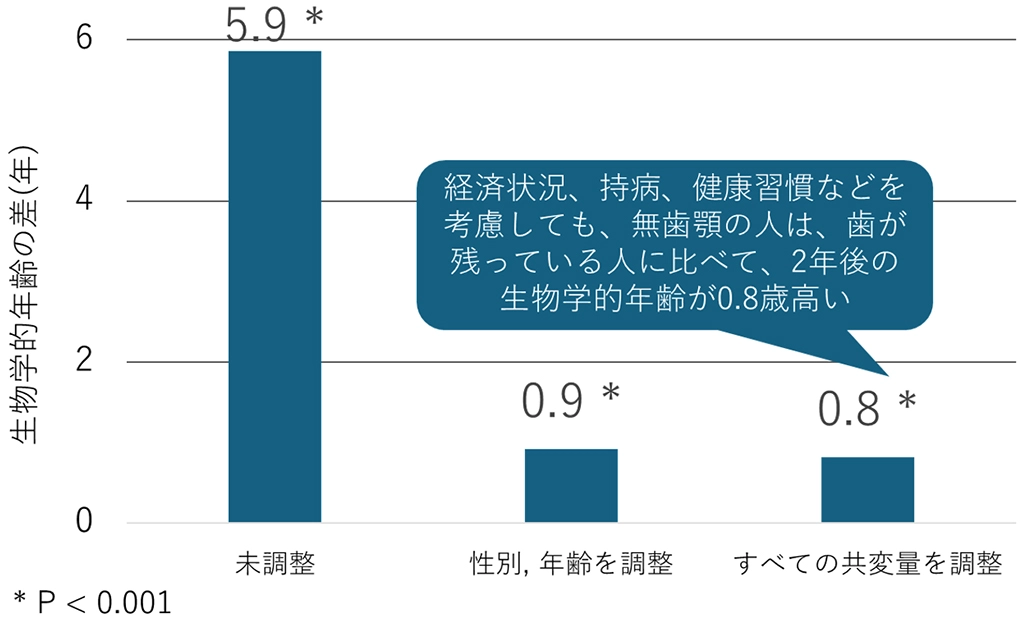
図. 無歯顎者と歯のある人における生物学的年齢の差
<関連情報>
- https://www.isct.ac.jp/ja/news/ttxrrjnsfmeo#top
- https://onlinelibrary.wiley.com/doi/10.1111/jcpe.70106
無歯症とその後の生物学的年齢との関連:コホート研究 Association of Edentulism With Subsequent Biological Age: A Cohort Study
Yusuke Matsuyama, Sakura Kiuchi, Jun Aida
Journal of Clinical Periodontology Published: 09 February 2026
DOI:https://doi.org/10.1111/jcpe.70106
ABSTRACT
Background
Biological ageing is characterised by a gradual decline in physiological functions, resulting in increased susceptibility to diseases and mortality. We investigated the relationship between edentulism and biological ageing among adults in England.
Methods
Data were drawn from participants in the English Longitudinal Study of Ageing who completed three consecutive biennial waves (waves 2–3–4 or 4–5–6), yielding 1889 individuals providing 2390 three-wave panel observations (mean age at baseline 68.1; men 47.7%). Edentulism was assessed in waves 3 and 5. Biological ageing was estimated using the Klemera and Doubal method, integrating multiple biomarkers assessed in waves 2, 4 and 6. Linear regression with clustered standard errors was employed to evaluate the association between edentulism and biological age in the subsequent wave (i.e., 2 years after the assessment of edentulism). Models were adjusted for pre-exposure confounders, including biological age, gender, socioeconomic status, existing health conditions and functional limitation assessed in the prior wave (i.e., 2 years before the assessment of edentulism).
Results
Participants with edentulism exhibited a 5.8-year greater biological age than those with some remaining teeth in the subsequent waves. After adjusting for confounding variables, edentulism was associated with a 0.82-year greater biological age than those with some remaining teeth (95% confidence interval: 0.40–1.24) in the subsequent waves.
Conclusion
Edentulism was longitudinally associated with a greater biological age. Strategies that incorporate oral health promotion, particularly the prevention of tooth loss, may contribute to healthy ageing.