2026-03-10 早稲田大学
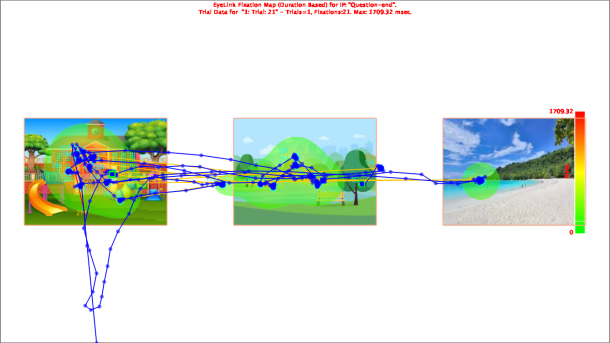
図1 視線計測を用いた実験
<関連情報>
- https://www.waseda.jp/inst/research/news/83680
- https://www.frontiersin.org/journals/language-sciences/articles/10.3389/flang.2026.1756463/full
L2予測における語彙手がかりと構造手がかりの使用:フィラーギャップ解析能力が学習者の情報利用を形作る Lexical vs. structural cue use in L2 prediction: filler-gap parsing ability shapes learners’ information use
Chie Nakamura,Suzanne Flynn,Yoichi Miyamoto,Noriaki Yusa
Frontiers in Language Sciences Published:04 March 2026
DOI:https://doi.org/10.3389/flang.2026.1756463
Abstract
This study examines whether second language (L2) sentence processing is governed by the same underlying mechanisms as native language processing or whether it relies on qualitatively distinct mechanisms. Using the visual-world paradigm and permutation analyses, we compared native English speakers and Japanese second language (L2) learners of English in processing globally ambiguous filler-gap dependencies (e.g., Where did Lizzie tell someone that she was going to catch butterflies?). By distinguishing L2 learners based on their comprehension accuracy for unambiguous filler-gap sentences, we identified systematic variation in the mechanisms guiding predictive processing. High-accuracy learners exhibited anticipatory eye-movement patterns comparable to those of native speakers, consistent with the use of structurally guided predictive dependency formation. In contrast, low-accuracy learners also showed predictive behavior, but this prediction was driven primarily by lexical or surface-level regularities rather than structural information. Importantly, neither the structure-based prediction observed in the high-accuracy group nor the lexical cue-based predictive observed in the low-accuracy group can be attributed to direct transfer from Japanese. Together, these results support a gradient view of L2 sentence processing in which qualitatively different predictive mechanisms coexist and may shift as a function of learners’ structural computation ability, rather than a simple contrast between non-predictive and native-like processing.