2026-06-09 シンガポール国立大学(NUS)
◆第1の研究では、GUSTOコホートに参加した479家族を対象に調査し、4歳半時点で父親が厳格かつ説明の少ない権威主義的養育を行っていた子どもほど、1年半後に不正行為(チート行動)を示す傾向が強かった。その背景には、子どもの自己批判性の高まりが関与していた。
◆第2の研究では、7~9歳の302家族を3年間追跡し、平手打ちやスパンキングなどの厳しい体罰が、嘘や不正行為の増加を予測することを確認した。また、不正行為をした子どもほど後により厳しい罰を受ける傾向もあり、悪循環が形成されることが示された。
◆研究者らは、厳格な養育が直接不正を生むのではなく、「失敗してはいけない」「良い成績でなければ愛されない」といった歪んだ自己認識を形成し、それが不正行為の心理的要因になると指摘している。子どもの誠実さを育むには、罰を強化するよりも心理的背景への理解が重要であるとしている。
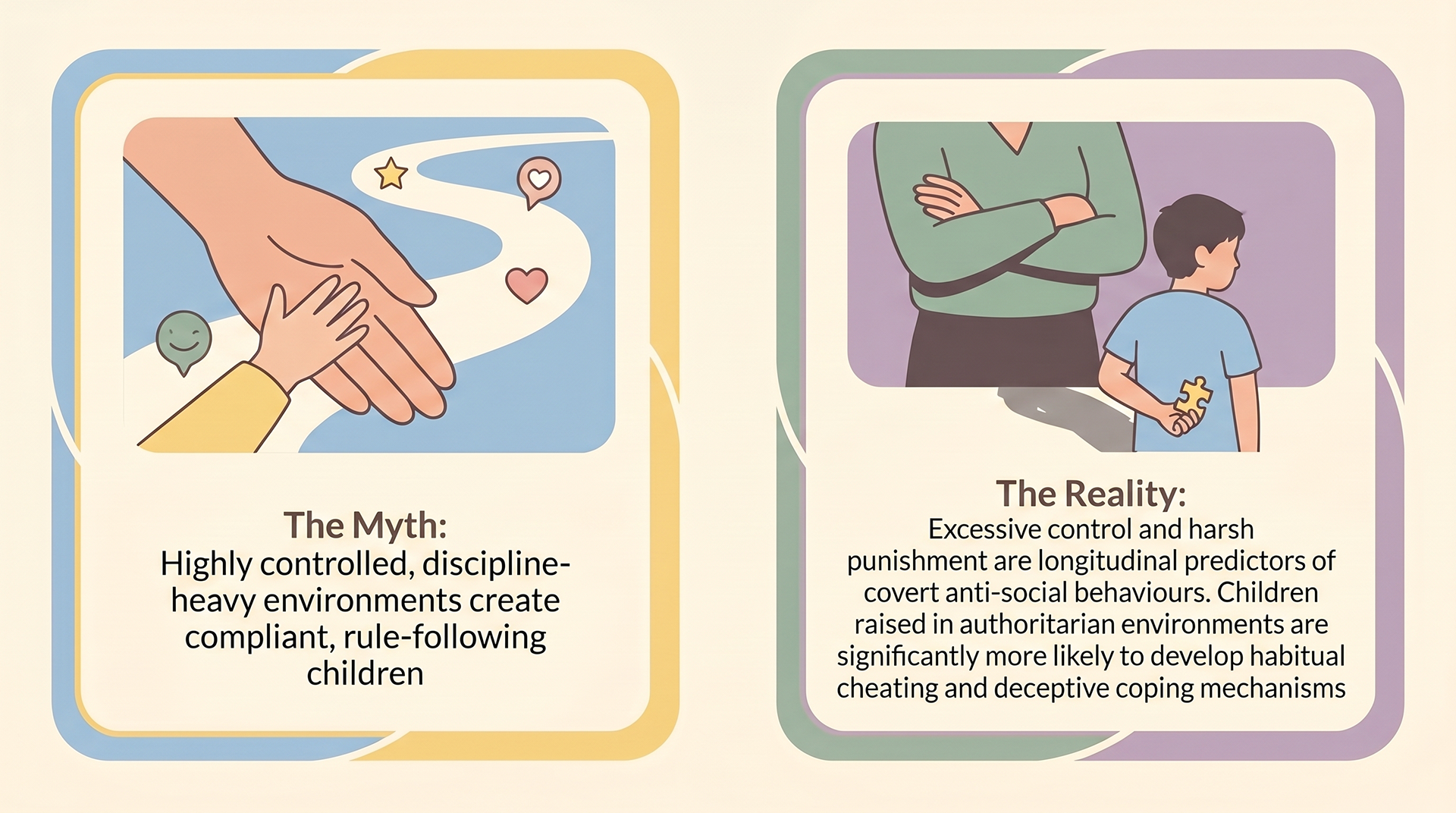
Myth vs Reality: Both NUS research studies challenge the belief that strict, controlling parenting creates rule-following children. Instead, harsh discipline predicts increased cheating and deceptive behaviours as children develop unhealthy coping mechanisms.
<関連情報>
- https://news.nus.edu.sg/nus-research-parenting-styles-influence-childrens-honesty/
- https://academic.oup.com/chidev/article/97/2/570/8468480
- https://psycnet.apa.org/record/2027-02129-001?doi=1
4歳半の時点で権威主義的な子育てをしている子どもは、6歳で不正行為をするようになる Authoritarian parenting at 4.5 years predicts children’s cheating at 6 years
Liwen Yu,Cleo Tay,Birit F P Broekman,Shirong Cai,Evelyn Law,Fabian Yap,Bobby K Cheon,Anne Rifkin-Graboi,Peipei Setoh,Henning Tiemeier,…
Child Development Published:09 February 2026
DOI:https://doi.org/10.1093/chidev/aacaf049
Abstract
Cheating is common in early childhood. However, limited empirical studies have explored the mechanism underlying the role of parenting in children’s cheating. This study (N = 479 Singaporean families; 219 female children; 55% Chinese, 27% Malay, 18% Indian; data collected between July 2014 and April 2017) examined whether and how authoritarian parenting at 4.5 years predicted children’s cheating 1.5 years later. When children were 4.5 years old, their self-criticism was assessed through the Etch-a-Sketch task, and mothers reported on both parents’ authoritarian parenting. At age 6, cheating was assessed using the Dart Game. Results showed that paternal authoritarian parenting predicted a higher likelihood of cheating, mediated by children’s self-criticism. Our findings can provide insights into promoting honesty within family environments.
親の否定的統制と子供の欺瞞的行動との間の縦断的関連性:子供の機能不全な態度の媒介的役割。 Longitudinal associations between parental negative control and children’s deceptive behavior: The mediating role of children’s dysfunctional attitudes.
Yu, Liwen Ding, Xiao Pan Hong, Ryan Y.
Developmental Psychology Published:2025
DOI:https://psycnet.apa.org/doi/10.1037/dev0002117
Abstract
Children begin to engage in deception at an early age, but such behavior becomes problematic during middle childhood. Although some cross-sectional studies have identified a link between parental negative control and children’s problematic deception, the developmental pathways remain unclear. Children’s dysfunctional attitudes, characterized by maladaptive beliefs about achievement and approval, may play a mediating role between parental negative control and children’s deceptive behavior. This study employed a three-wave longitudinal design to examine the influence of parental negative control on parental assessment of children’s deceptive behavior during middle childhood and to explore the mediating role of dysfunctional attitudes in this relationship. A sample of 302 Singaporean families (42% with female children) participated. Primary caregivers reported their use of parental negative control (including harsh parental punishment, discipline, and ignoring) and their children’s frequency of deceptive behavior at ages 7, 8, and 9. Additionally, children self-reported their dysfunctional attitudes at ages 8 and 9. The results revealed that harsh parental punishment at ages 7 and 8 predicted parental assessment of children’s deceptive behavior 1 year later. Children’s deceptive behavior at age 8 also predicted harsh parental punishment at age 9. Furthermore, children’s dysfunctional attitudes at age 9 mediated the effect of parental negative control at age 8 on parental assessment of children’s deceptive behavior at age 9. These findings suggest that children’s maladaptive social information processing might play a critical role in the development of problematic deception, potentially as a coping mechanism in reaction to harsh parental punishment. (PsycInfo Database Record (c) 2026 APA, all rights reserved)