2026-06-11 国立循環器病研究センター
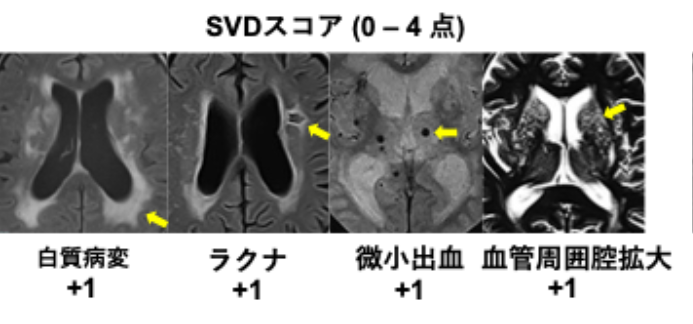
◆研究では、抗血栓薬を服用する脳・心血管疾患患者5,378人を2年間追跡し、MRIで評価したSVDスコアと身体機能の変化を解析した。SVDスコアは白質病変、ラクナ、脳微小出血、血管周囲腔拡大の4所見から0~4点で評価される。その結果、SVDスコア3以上の患者では、スコア0の患者に比べて日常生活自立度を示すmRSが1点以上悪化するリスクが有意に高かった。さらに媒介解析では、身体機能低下への影響は脳梗塞や脳出血、心筋梗塞などの発症を介する経路よりも、SVDそのものによる直接的な影響の方が大きいことが示された。これは、微小血管障害による慢性的な脳ネットワーク機能低下が歩行障害や機能低下を進行させる可能性を示唆する。
◆研究成果は、脳小血管病が脳卒中予防だけでなく健康寿命維持の重要な標的であることを示し、SVD自体への治療介入や予防戦略の必要性を強く支持するものである。
<関連情報>
- https://www.ncvc.go.jp/pr/release/pr_52774/
- https://www.ahajournals.org/doi/full/10.1161/STROKEAHA.125.054738
脳小血管疾患が機能低下に及ぼす影響:抗血栓療法による出血2試験 Impact of Cerebral Small Vessel Disease on Functional Decline: Bleeding With Antithrombotic Therapy 2 Study
Yoshito Arakaki, MD, Kaori Miwa, MD, PhD, Masatoshi Koga, MD, PhD, Sohei Yoshimura, MD, PhD, Kanta Tanaka, MD, PhD, Jin Nakahara, MD, PhD, Yusuke Yakushiji, MD, PhD, … for BAT2 Investigators
Stroke Published: 1 June 2026
DOI:https://doi.org/10.1161/STROKEAHA.125.054738
Abstract
BACKGROUND:
To what extent cerebral small vessel disease (SVD) contributes to functional disability remains unclear. We investigated the longitudinal effect of SVD burden on functional decline.
METHODS:
In this investigator-initiated, prospective, multicenter, and observational study, patients receiving oral antithrombotic therapy for cerebrovascular or cardiovascular diseases were enrolled from 52 hospitals across Japan (2016–2019) and followed for 24 months. SVD score (range, 0–4) was calculated on baseline magnetic resonance imaging obtained under prespecified conditions. The outcomes were an increase in modified Rankin Scale (mRS) score from baseline to end of follow-up (ΔmRS score ≥1). Logistic regression evaluated the association between ΔmRS score ≥1 and SVD score, adjusting for age, sex, premorbid mRS, vascular risk factors, antithrombotic therapy, magnetic resonance imaging field strength, and bleeding or ischemic events during follow-up. Bleeding and ischemic events were treated as time-dependent covariates. Causal mediation analyses using a 4-way decomposition separated the effects of SVD score ≥3 on ΔmRS score ≥1 into direct and indirect effects (mediated by major bleeding or ischemic events).
RESULTS:
Of 5378 patients enrolled, 613 were excluded mainly due to the lack of clinical or imaging data. Finally, 4765 patients were analyzed (1573 women; median age, 73 years); ΔmRS score ≥1 was observed in 13.2% of patients with SVD score 0, 16.1% with 1, 20.7% with 2, 28.1% with 3, and 28.2% with 4. SVD score of 3 (adjusted odds ratio, 1.65 [95% CI, 1.27–2.15]) and SVD score of 4 (1.62 [95% CI, 1.19–2.19]) were associated with ΔmRS score ≥1 compared with SVD score of 0. Causal mediation analysis indicated that 73.05% of the total effect of SVD score ≥3 on ΔmRS score ≥1 was attributed to the controlled direct effect (coefficient, 0.497 [95% CI, 0.26–0.73]).
CONCLUSIONS:
SVD burden was associated with functional decline beyond significant bleeding or ischemic events.