2026-06-17 中国科学院(CAS)
◆深海堆積物では無機リンが乏しい一方、有機リンが豊富に存在するが、微生物がどのようにリンを利用しているかは不明だった。研究チームは南シナ海の冷湧水域や海山から8株のメタン生成古細菌を分離し、細胞内にポリリン酸(polyP)顆粒を発見した。さらに、PPK1酵素がポリリン酸合成を担い、ppk1遺伝子を欠損させると増殖速度とメタン生成量が大幅に低下することを確認した。また、無機リンが不足すると、デンプンやキトサン由来の有機リンをホスホエステラーゼで分解し、得られたリンをポリリン酸として蓄積・利用することが判明した。転写解析ではリン輸送系(Pst系)やppk1の発現増加も確認された。
◆本研究は、深海微生物が受動的にリン不足へ適応するのではなく、リンの獲得・貯蔵・利用を能動的に制御していることを示し、深海における炭素循環とリン循環の連関理解を大きく前進させた。
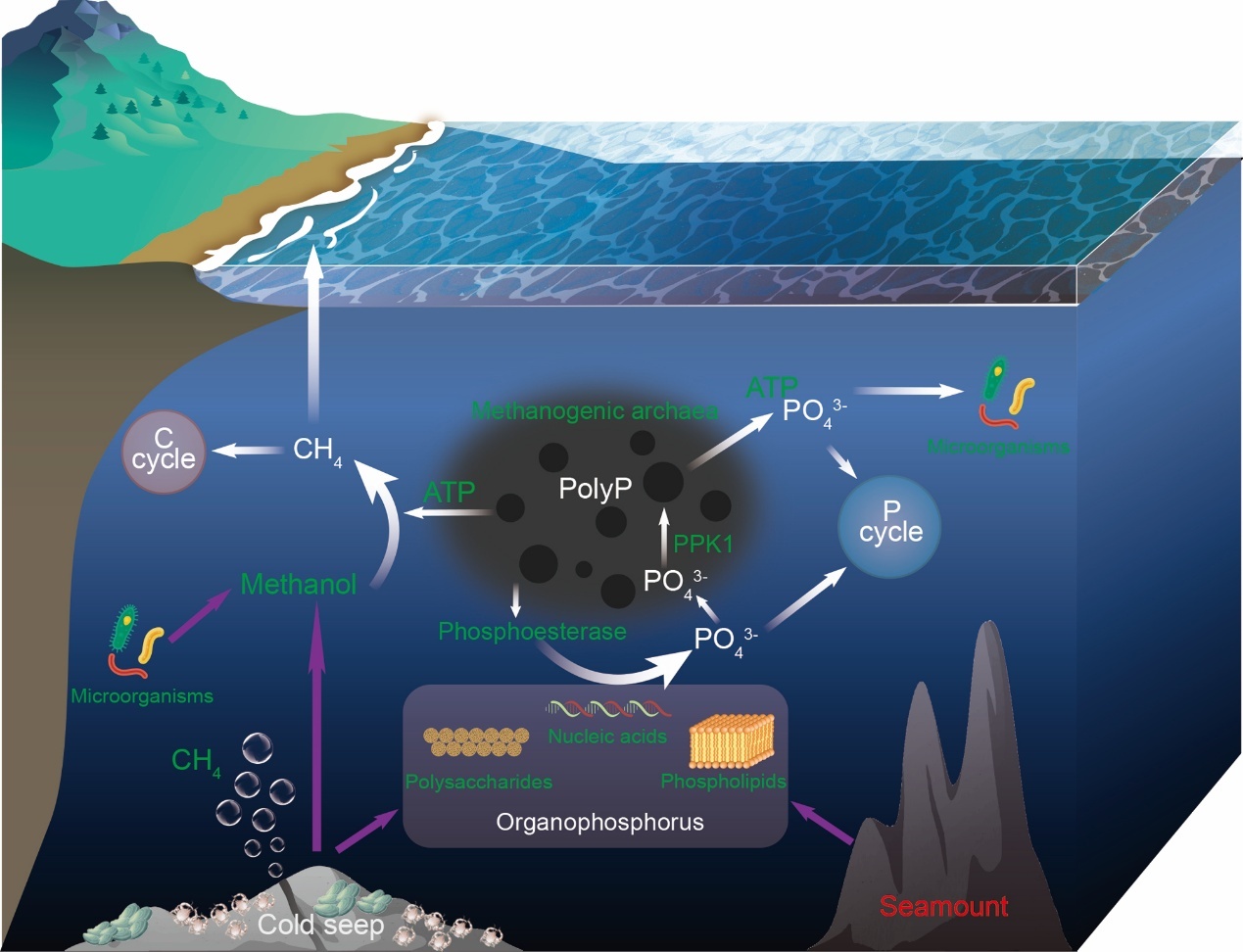
Schematic diagram showing the coupling of carbon and phosphorus cycling driven by deep-sea methanogenic archaea. (Image by ZHENG Rikuan)
<関連情報>
- https://english.cas.cn/newsroom/research-news/202606/t20260618_1174056.shtml
- https://www.pnas.org/doi/10.1073/pnas.2608127123
ポリリン酸は深海メタン生成古細菌の増殖とメタン生成に影響を与える Polyphosphate affects the growth and methanogenesis of deep-sea methanogenic archaea
Rikuan Zheng, Chong Wang, Yuxin Zheng, +3 , and Chaomin Sun
Proceedings of the National Academy of Sciences Published:June 1, 2026
DOI:https://doi.org/10.1073/pnas.2608127123
Significance
Polyphosphate kinase 1 (PPK1) catalyzes the synthesis of inorganic polyphosphate (polyP), a linear polymer of phosphate residues that serves as an energy and phosphate storage molecule. This study shows that a deep-sea methanogenic archaeon accumulates substantial amounts of polyP and may utilize it as a dynamic phosphorus reservoir. We suggest PPK1-driven polyP synthesis contributes to the optimal metabolic output and that the organism employs phosphoesterases to scavenge organic phosphorus from its environment—a potential strategy supported by laboratory and in situ transcriptomics. These findings suggest polyP serves as a dynamic metabolic hub in this deep-sea methanogenic archaeon, linking phosphate availability to growth and methanogenesis, and reveal a phosphorus acquisition strategy that may contribute to persistence in the oligotrophic deep sea.
Abstract
Microorganisms employ inorganic polyphosphate (polyP) as an ancient strategy for energy and phosphate storage, yet its physiological roles in methanogenic archaea remain largely unexplored. Here, we report that polyP metabolism is coupled to growth and methanogenesis in Methanolobus sp. ZRKC1, a representative of eight methanogenic archaea isolated from deep-sea cold seep sediments. Through combined genetic, biochemical, and physiological analyses, we find that PPK1 mediates polyP synthesis in a Mg2+-dependent manner, whereas PPK2 functions primarily as a polyP hydrolase. Deletion of ppk1 in strain ZRKC1 abolishes polyP accumulation and impairs both growth and methane production, pointing to a role for polyP as a metabolic hub linking these processes. Transcriptomic profiling reveals that under organic phosphorus conditions, strain ZRKC1 upregulates phosphoesterases to liberate bioavailable phosphate, which is subsequently channeled into polyP via PPK1. Furthermore, in situ transcriptomic data suggest that the genetic capacity for this metabolic strategy may be present and transcriptionally active in the native environment, with concurrent upregulation of genes involved in phosphate acquisition, polyP metabolism, and methanogenesis. Our findings suggest the importance of polyP in linking phosphate homeostasis to growth and methanogenesis in deep-sea methanogenic archaea.